
Today marks the 76th anniversary of the liberation of Sachsenhausen Concentration Camp. I can’t think of a better way to observe it than to republish the post I wrote one year ago:
April 22, 1945: Thomas Buergenthal Liberated
Seventy-five years ago today, Polish and Russian armed forces liberated Sachsenhausen Concentration Camp, and with it, Thomas Buergenthal.
Tom was nineteen days shy of his 11th birthday. He had been a captive, in one form or another, of the Nazis since early 1940, when he and his family were herded into the Kielce Ghetto in Poland. Tom was then just over five and a half years of age, meaning that, by April 1945, he had spent approximately half of his entire existence on earth as a prisoner.
And Tom had known fear even before the war began. He sensed his mother’s trepidation when the two of them were ordered to the local police station in Zilina, Czechoslovakia in early 1939. The family had fled to Zilina from their home in Ľubochňa, having been dispossessed of the hotel Tom’s father owned and ran there. The family now fled Zilina as well, and Tom had to sleep in a ditch when trapped in the no-man’s-land between the Czech and Polish borders. He was not yet five years old.
And now Tom was free.
But what did freedom mean to a ten-year-old child?
Where were his parents? He had last seen his father, Mundek, in October 1944, when he and Mundek were separated while in Auschwitz, and his father sent off to other camps (including, for a short time, Sachsenhausen), before succumbing to pneumonia in Buchenwald in January 1945. He had seen his mother, Gerda, only once in Auschwitz, around the same time as his father was taken away. Tom spotted her through the wire—thin, her hair shorn, tear covered—before she too was sent away to another camp: Ravensbrück.
How would Tom find them? Where would he look? How could he even begin? Another year and a half would pass before Tom and his mother were miraculously reunited (movingly told in his memoir, A Lucky Child).
On April 22, 1945, then, what were Tom’s prospects? Almost eleven, and yet still illiterate, Tom had had only one type of schooling—the school of survival. He had done well in that school, a necessary experience for what lay ahead, but hardly sufficient.
What could Tom possibly aspire to?
Meanwhile, on the exact same date—April 22, 1945—but a world away, delegates from 46 countries began gathering in San Francisco to commence, in the words of William L. Shirer, “the difficult job of setting up the machinery of peace,” the United Nations. And for all its shortcomings, the delegates did get some things right. “[I]t will give us a better world organization than was the old League at Geneva,” wrote Shirer, “[T]here is to be an International Court of Justice, functioning as the judicial organ of the United Nations.”
“The arc of the moral universe is long, but it bends toward justice,” is a phrase that goes back to an anti-slavery sermon in 1853, and has been used by many since, including Martin Luther King and Barack Obama.
Who could have known, back in that chaotic, uncertain world of April 1945—certainly not the delegates, and least of all Tom Buergenthal—that one day, six and a half decades later, this newly freed child prisoner would become a distinguished member of that same International Court of Justice.
I salute you, my dear friend Tom, and the wonderful new life of yours that began, however fitfully, 75 years ago today.
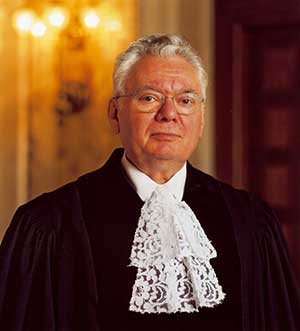
Thomas Buergenthal

