
On this date in 1945, the Ohrdruf concentration camp was liberated. This is notable for three reasons:
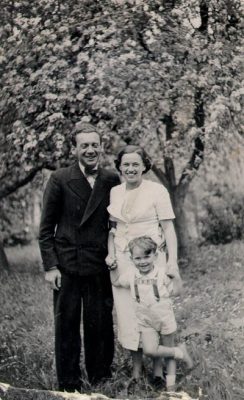
FIRST: Thomas Buergenthal’s father Mundek died in Ohrdruf just weeks earlier, on January 15, 1945. Tom and Mundek were separated in Auschwitz in late October, 1944, when Mundek was moved to Sachsenhausen, arriving there on October 26, 1944. [Did Odd Nansen and Mundek Buergenthal ever cross paths in Sachsenhausen? That’s the subject for another post.] Three weeks later Mundek was moved yet again, to Ohrdruf, a subcamp of Buchenwald, arriving November 13, 1944. Two months later he was dead.
Mundek had displayed great resilience, courage, and resourcefulness in meeting, and overcoming, every challenge the Nazis presented him with for almost five and a half years—ever since September 1, 1939. That was when the train he, Tommy, and Tommy’s mother Gerda were riding on through Poland, on their way to freedom, was strafed by the invading Nazis. Mundek managed to keep his family alive in the Kielce Ghetto (which was later liquidated), and in two work camps outside Kielce (which were also later liquidated). If he had only been able to hold on for another 79 days, he, too, might have been liberated, and Tommy’s life utterly changed. His unfortunate death is yet one more of the countless tragedies of the Holocaust.
SECOND: Ohrdruf has the distinction of being the very first Nazi concentration camp liberated by the U.S. Army—units of the 602nd Tank Destroyer Battalion, the 4th Armored Division, and the 89th Infantry Division all participated.
The camp had only been established in November 1944, initially as an independent site, and later as a subcamp of Buchenwald, located 30 miles to the east. It was established to supply forced labor to construct a rail line to a proposed communications center. (Neither the communications center nor the rail line was ever completed.)
Conditions at Ohrdruf were particularly brutal: 14-hour workdays, strenuous physical labor, insufficient food, clothing, and medical supplies. It is estimated that 3,000 of the camp’s roughly 10,000 prisoners died of exhaustion or disease during its short existence.
The camp was evacuated on April 1, 1945, just ahead of the advancing Allied armies, when SS guards initiated a death march of the remaining prisoners to Buchenwald. Those deemed too ill or too weak to undertake the trip were murdered and their bodies burned in a giant pyre.
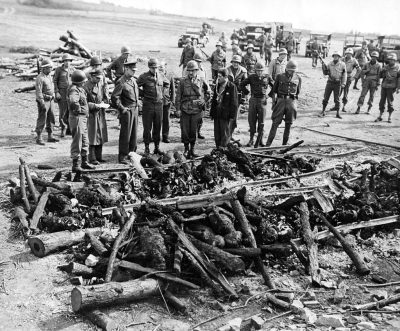
THIRD: The conditions in Ohrdruf which greeted the liberating U.S. forces were so appalling that General Eisenhower, Supreme Commander of all Allied Forces in Europe, personally visited the camp on April 12, 1945, accompanied by Generals George Patton and Omar Bradley. In his postwar memoir, Crusade in Europe, Eisenhower wrote: “[On April 12] I saw my first horror camp. I have never felt able to describe my emotional reactions when I first came face to face with indisputable evidence of Nazi brutality and ruthless disregard of every shred of decency. Up to that time I had known about it only generally or through secondary sources. I am certain, however, that I have never at any other time experienced an equal sense of shock.”
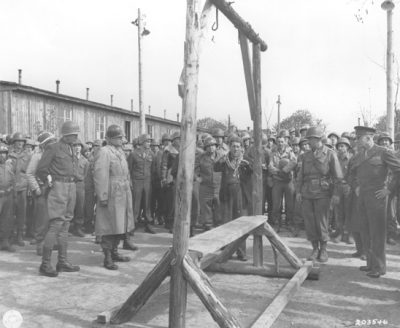
In a subsequent cable to General George Marshall, Chief of Staff of the U.S. Army, Eisenhower further elaborated: “The things I saw beggar description. . . . The visual evidence and the verbal testimony of starvation, cruelty and bestiality were so overpowering as to leave me a bit sick. In one room . . . George Patton would not even enter. He said he would get sick if he did so. I made the visit deliberately, in order to be in a position to give first-hand evidence of these things if ever, in the future, there develops a tendency to charge these allegations merely to ‘propaganda.’” (emphasis added)
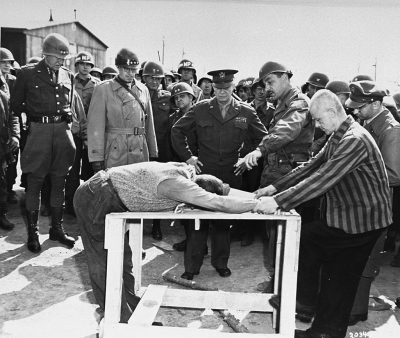
Is it any wonder that Mundek Buergenthal, who had survived the Kielce Ghetto, the Arbeitslager, the Henryków factory complex, Auschwitz, and Sachsenhausen, was unable to survive Ohrdruf?
In a practice that was to be repeated in subsequent camp liberations, German citizens from the nearby town of Ohrdruf were forced to view the camp and help bury the dead. Following the tour, the town’s mayor and his wife both hanged themselves.
It has been reported that, after seeing Ohrdruf, Eisenhower was heard to remark:
“We are told the American soldier does not know what he is fighting for. Now, at least, we know what he is fighting against.”

