
Happy Birthday, Fiskerjente

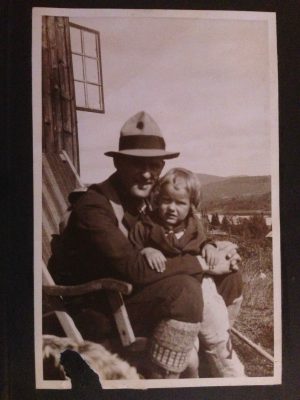
Odd Nansen and Marit, 1930s

Today is Marit (Nansen) Greve’s birthday.  She would have been 93 years old.

Odd Nansen wrote about Marit in his diary on November 8, 1944, while in Sachsenhausen, using “fiskerjente,” meaning “fisher girl” as a term of endearment.  After all, she had often accompanied him in the prewar era when he went out fishing, something he greatly enjoyed.  Nansen worried in his diary that their long separation, and those crucial years in Marit’s young life—from age 13 to age 16—without her father, would cool her affection for him.

Nansen needn’t have worried.  Marit was the keeper of the flame, and throughout her long life worked diligently, but unobtrusively, at the Grini Museum and the Fram Museum, to ensure that her father’s and grandfather’s legacies would endure.  Without her help, the current edition of Odd Nansen’s diary would have been significantly poorer.

Marit passed away last March 26.  She had lived a long and full and productive life, spanning so many important years in the life of her country and her family.  She had left nothing undone.  It was her time to go.

Nevertheless, to borrow the same words her father wrote 77 years ago today: “But all the same I miss you badly, my little “fisher girl.”

From Day to Day: One Man’s Diary of Survival in Nazi Concentration Camps

Hailed by The New Yorker as “among the most compelling documents to come out of the war,” From Day to Day is a World War II concentration camp diary—one of only a handful ever translated into English—secretly written by Odd Nansen, a Norwegian political prisoner. Arrested in January 1942, Nansen, son of polar explorer and humanitarian Fridtjof Nansen (Nobel Peace Prize 1922) was held captive for the duration of the war in various Nazi camps in Norway and Germany.

Nansen’s diary entries detail his palpable longing for his wife and family, his constantly frustrated hopes for release, the quiet strength and sometimes ugly prejudices of his fellow prisoners, and his horror at the especially barbaric treatment reserved for the Jews. The diary brilliantly illuminates Nansen’s daily struggle, not only to survive, but to preserve his sanity and maintain his humanity in a world engulfed by fear and hate.

First published in English in 1949, From Day to Day had been out of print for almost seventy years. The new edition contains entries and sketches never previously available in English. It also features a new introduction and extensive annotations by Timothy Boyce and a preface by Thomas Buergenthal, whose life (as a ten year-old) Nansen saved while in Sachsenhausen, later recounted in his own memoir A Lucky Child: A Memoir of Surviving Auschwitz as a Young Boy.