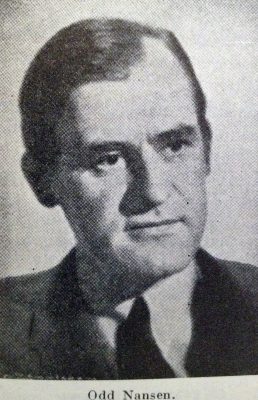
Today marks the 122nd anniversary of Odd Nansen’s birth, in 1901.
Sometimes I ask myself why I have become so enamored of a person I never met; why do I spend so much time devoted to a diary he wrote, before I was even born, and which I still have difficultly fully appreciating—the description is so divorced from any personal experience I have ever had.
Recently I read for the first time, the front inside dust jacket from the original, 1949 English-language version of From Day to Day. It is worth quoting:
“To convey the flavor of Odd Nansen’s remarkable diary, kept while a prisoner in German concentration camps, in a brief description is impossible, for the essence of it is the spiritual quality that shines out on every page—the magnanimity, the tolerance, the humor, above all the humaneness of this daily record (emphasis mine).”
Interestingly, I also recently read a review in The York Review of Books of a newly published book entitled Theresienstadt 1941-1945: The Face of a Coerced Community by H.G. Adler. Adler (1910—1988) was Czech Jew (like Ilse Weber) who, also like Weber, was deported to Theresienstadt in February 1942. His wife Gertrude could have survived, but chose not to leave her own mother, and so was gassed in Auschwitz. Adler was also transported to Auschwitz, but survived as a forced laborer, and ultimately emigrated to England in 1947 in anticipation of the Communist takeover of Czechoslovakia. He lost 18 relatives to the Holocaust.
Adler resolved, while in Theresienstadt, that if he survived, he would write about the camp I detail. He left notes and materials behind when he was transported to Auschwitz (again, like Weber’s husband, Willi), accumulated more material after his liberation, and published his research, in German, in 1955. An expanded second edition appeared in 1960, and was reprinted again in 2005 with an afterword by his son, Jeremy. This version has only recently been translated into English, published by Cambridge University Press.
Not surprisingly, Adler’s book spends a great deal of time examining the role of the Jewish Council of Elders which administered Theresienstadt at the behest of the SS. Also not surprisingly, he found their actions often falling short—corrupt, focused on self-preservation, condoning favoritism, etc. However, the reviewer, Thomas Nagel, observes:
“The one positive conclusion [Adler] drew from his dark experiences is that there is nonetheless a ground of morality that is in principle always available. Adler calls this personal quality ‘humaneness’ (Menschlichkeit, also translatable as ‘humanity”)—an inner resource that enables individuals of sufficient strength to act morally in any circumstance, however horrible.”
I guess it is this quality of “humaneness” that initially attracted me to, and still attracts me to, Odd Nansen. I end virtually all my presentations with an observation that Nansen’s humane example, evidenced throughout his diary, should serve as an inspiration to us all—of how to “act morally in any circumstance, however horrible.”
Happy Birthday, Odd Nansen