

When we last left Norway in 1940 (here), it was reeling from an invasion by German forces which began on April 9, 1940.
The Germans had achieved complete surprise, and quickly seized key ports and airports. Practically the only thing that went well for the defenders was the sinking of the German heavy cruiser Blücher, which was steaming up the Oslo Fjord on the morning of April 9 when well-placed artillery and torpedo fire from Oscarsborg Fortress sank her. The mission of the Blücher had been to seize the capital, Oslo, and the ship’s destruction gave the King, government officials, the Parliament (Storting) and, crucially, Norway’s gold supply (23 tons worth), enough time to flee Oslo by train.
Initially German officials, led by envoy Curt Bräuer, tried to negotiate with King Haakon VII, to convince him that resistance was futile, and that it was in Norway’s interest to capitulate—much like what had occurred in Denmark, where the king and government capitulated without almost a shot being fired. By April 10, however, the 67 year-old King, with the support of his government, rejected any surrender, and elected to fight on:
“In this most difficult time that my people and my country find themselves in . . . I ask all Norwegian women and men to do all they can to save freedom and independence for our dear fatherland. God preserve Norway.”
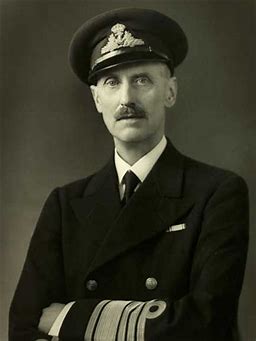
From then on, the mission of German forces was to capture or kill Haakon, and he was hunted through the interior of Norway, always staying one step ahead of his pursuers.
By late April, the King elected to move to Molde, Norway, a small seaport town, but with a large and busy harbor, to set up his government until Trondheim was recaptured. [By this time, British, French and Polish forces had landed in Norway to help drive the invaders out. The King—and almost all Norwegians—were confident they would succeed. Instead, the outgunned and outmanned Allies failed miserably and eventually withdrew.] The King arrived in Molde on April 23—seventy-eight years ago tonight.
I have previously written about my friend, Siri Svae Fenson (here), whose uncle, Hjalmar Svae, attempted to escape to England during the war, was captured and sentenced to death, only to make a daring escape from prison, and ultimately to freedom in Sweden, and later England and Canada.
Well, the Svae saga is not quite over yet.
While in Molde, King Haakon stayed at a villa on the outskirts of town called Glomstuen. Glomstuen was the home of Jacob Preuthun (the regional forest director), and his wife, Mathilde Petersen. Mathilde Petersen, it turns out, was Siri Fenson’s great-aunt.
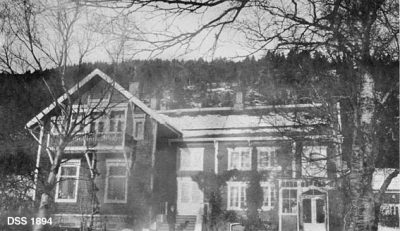
By April 25th, German intelligence was aware of Haakon’s presence in Molde, and began an unrelenting bombing campaign targeting the city. As Tim Greve, the King’s biographer, notes in Haakon VII of Norway: “Undoubtedly the object was to kill the King, the Crown Prince and as many of the [government] ministers as possible.” [Incidentally, Tim Greve was Odd Nansen’s son-in-law, and the late husband of my dear friend, Marit (Nansen) Greve.]
The idea of the royal party dashing from Glomstuen into the adjacent snow-covered forest to escape the near constant German raids wreaking destruction on Molde is more than a bit ironic, inasmuch as Kaiser Wilhelm himself had visited Molde each summer prior to World War I, where he was a guest at none other than Glomstuen!
The picture shown at the top of this blog, of the King consulting with his son beside a large birch tree—one of the most iconic pictures of Norway during the invasion—was taken at Glomstuen. There is a plaque nearby commemorating this famous scene.
Although Glomstuen itself was never hit, by April 28 Molde was practically in ruins, and it was clear that Haakon would have to leave. The following day the British cruiser HMS Glasgow, with an escort of two destroyers, arrived in port to transport the King, Crown Prince, cabinet members, and gold supply to Tromsø, 600 miles farther north. “By nightfall Molde was a roaring bonfire,” writes historians Hans Christian Adamson and Per Klem in Blood on the Midnight Sun. The royal party and the government made good their escape. But by then Molde, a quaint, idyllic town whose lush gardens and parks had earned it the nickname The Town of Roses, was almost 70% destroyed.
Siri Fenson’s mother relates one particularly comic episode in what was an otherwise bleak time in Norway’s history. One day, the air raid sirens sounded just as a fish gratin had been placed in the oven at Glomstuen. The cook, named Kristine, was out of action, having broken her leg in an earlier sprint to the woods. So, Mathilde, fearing for the fate of the untended fish gratin, left her hiding place, dodged the attacks, dashed back into the house and rescued the savory dish.
After the war, Mathilde was invited to an audience at the royal castle in Oslo. There, King Haakon, after having just lived five years in exile in England, posed a question which apparently had haunted him all that time: “Tell me, Mrs. Preuthun—how did you manage to save the fish gratin?”

