
On May 22, 1939, Germany and Italy signed the Pact of Steel, or more formally, the Pact of Friendship and Alliance between Germany and Italy, thereby converting the Rome-Berlin Axis into a military alliance. The Pact was executed by Foreign Ministers Galeazzo Ciano and Joachim von Ribbentrop at the Reich Chancellery in Berlin.
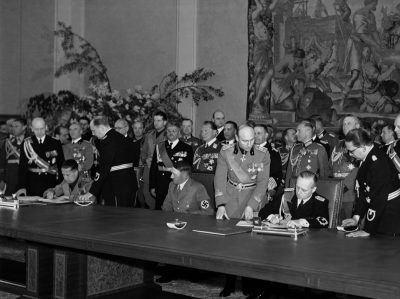
Both parties agreed that if either “contrary to the[ir] wishes and hopes,” should find themselves at war, the other party “would immediately come to its assistance as an ally and support it with all its military forces on land, the sea and in the air.” Furthermore, neither party would conclude an armistice or separate peace without the agreement of the other.
Notwithstanding the expressed “wishes and hopes” to avoid war, the agreement was clearly aggressive in nature. Hitler insisted that the Preamble declare the two countries “united by the inner affinity of their ideologies . . . are resolved to act side by side and with united forces to secure living space.” To Winston Churchill, the Pact was “the challenging answer to the flimsy British network of guarantees in Eastern Europe.”
In a single stroke, Hitler secured his southern flank (Italy had fought against Germany in the First World War), gained a bellicose ally who had been consistently courted by the western powers, and signaled his determination to impose his will on Europe. In fact, the very next day, May 23, 1939, Hitler secretly convened his top military brass and informed them that war was inevitable. “We are left with the decision to attack Poland at the first suitable opportunity. We cannot expect a repetition of the Czech affair. There will be war.” Mussolini in turn gained an ally that was the ascendant military power in Europe.
In the meantime, the western democratic powers, France and Great Britain, remained divided, uncertain, and committed to appeasement. They had capitulated to the dismemberment of Czechoslovakia in the Munich Agreement of September 1938. They had stood by when the Nazis seized the rest of Czechoslovakia in March 1939 (witnessed first-hand by Odd Nansen). And they would temporize again when Germany invaded Poland in September 1939.
To all appearances, then, the Pact of Steel seemed like yet another brilliant strategic move by Hitler and Mussolini.
Sometimes, however, appearances can be deceiving. As William L. Shirer noted in The Rise and Fall of the Third Reich, “This was one of the first signs that the Italian dictator, like the German, was beginning to lose that iron self-control which up to this year of 1939 had enabled them both to pursue their own national interests with ice-cold clarity.”
In hindsight, perhaps the most acute and accurate summary of the consequences that flowed from the Pact of Steel comes from Andre Francois-Poncet, French Ambassador to both Germany (1931—1938) and Italy (1938—1940):
“Their [Hitler and Mussolini’s] friendship proved equally fatal to both. Without Mussolini, Hitler could never have carried out his plans for conquest and his ambition for hegemony. Without Hitler, Mussolini, contenting himself with making speeches, would never have yielded to his most dangerous temptations. Separately they might have lived; their union caused their destruction, and in the last analysis each died through the agency of the other.”
And what of the signatories to the Pact of Steel, and their principals, in their gaudy uniforms, surrounded by their staffs and the considerable pomp of the Reich Chancellery?
Von Ribbentrop became the first of the Nazis convicted at Nuremburg to be hanged, on October 16, 1946. Hitler had committed suicide eighteen months earlier, on April 30, 1945.
Ciano was executed by firing squad on January 11, 1944, on orders from his own father-in-law, Benito Mussolini; Mussolini would be killed by Italian partisans two days before Hitler’s suicide, on May 28, 1945.
Hubris indeed.

