
“God, why do we have to suffer all this?” Diary of Mary Berg, June 15, 1943
I have previously written about the Warsaw Ghetto several times already—primarily as seen through the eyes of teenage diarist Mary Berg.
Part I described the establishment of the Ghetto in September 1940; the lethal living conditions which consigned thousands of inhabitants to death by disease or slow starvation; the start of Grossaktion Warschau on July 25, 1942, sending many inhabitants to their death at Treblinka, a Vernichtungslager (death camp), a process that murdered 250,000 to 300,000 Jews within the space of 60 days.
The deportations to Treblinka from the Warsaw Ghetto were suspended for a brief time (September 21, 1942 – January 18, 1943).
Part II explained how the resumption of deportations was met for the first time with concerted resistance on the part of the Ghetto’s remaining inhabitants, now numbering approximately 63,000 men, women, and children. Unlike the initial wave of deportations, where the Germans promised—and the inhabitants believed—”resettlement” to labor camps “in the East,” by 1943 the existence, and purpose, of Treblinka was well known. According to Berg, “Many Jews barricaded themselves in their houses and fired at the manhunters.” Others deliberately infiltrated columns of rounded-up Jews, and, at a signal, stepped out and attacked the Nazis. After a few days, the Germans had only been able to collect 5,000—6,000 Ghetto dwellers for transport, at considerable cost to their own forces, and the Germans elected to withdraw from the Ghetto.
The Ghetto’s remaining population now engaged in feverish activity in anticipation of renewed German efforts to collect and deport the remaining inhabitants. These survivors had no illusions. According to Berg, “They knew that their fate was sealed, that the Nazis had decided to exterminate the Jewish population completely.” Water, food, and medicines were stockpiled; bunkers prepared; arms smuggled in from the outside. It was only a question of time before the Germans would return, more determined than ever.
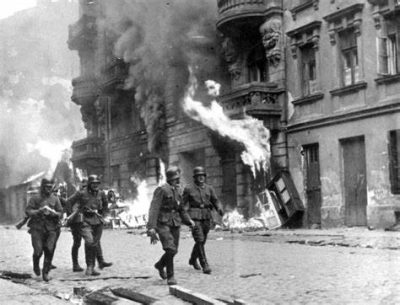
That day arrived 80 years ago today, April 19, 1943, a date chosen by the Nazis because it was the eve of the start of the Jewish holiday of Passover.
The Germans came with tanks, heavy artillery, flamethrowers. They employed members of the police, Wehrmacht, Gestapo, and Waffen-SS, among others. When the defenders refused to surrender, the German’s commander, Jürgen Stroop* ordered all structures in the Ghetto to be systematically burned and/or destroyed, block by block. Berg observes that, “For many nights, the fire of the ghetto could be seen for miles around Warsaw.” The suppression of the uprising officially ended May 16, 1943, although sporadic skirmishes with holdouts continued as late as June 5, 1943. In the end, all but eight buildings in the Warsaw Ghetto were destroyed. Approximately 7,000 Jews were killed during the uprising, many via suffocation from smoke inhalation or from being burned alive. The remaining population (50,000) were captured and deported to the death camps of Treblinka and Majdanek.
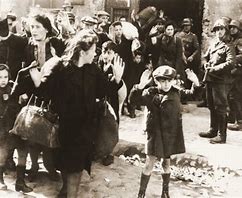
Today, with the memory of Yom HaShoah fresh in our minds, it is fitting to reflect on those who fought and died for the honor of the Jewish people. As eloquently commemorated by Mary Berg:
“The Battle of the Ghetto lasted for five weeks. Its starved, exhausted defenders fought heroically against the powerful Nazi war machine. They did not wear uniforms, they had no ranks, they received no medals for their superhuman exploits. Their only distinction was death in the flames. All of them are Unknown Soldiers, heroes who have no equals. How horrible it is to think of all this—so many relatives and friends among them. . . . I have been standing at my window for the last few days [in an internment camp in France] talking with the newly arrived internees [from the Ghetto]. I drank in their words avidly, and my thoughts carried me over there, to the burning houses of the ghetto where I had lived for three years with all these heroes. Every now and then I felt faint, as if my very heart had withered. . . . “
Diary of Mary Berg, June 15, 1943
The Warsaw Ghetto Uprising was the largest single revolt by Jews during World War II.
TO BE CONTINUED
* Stroop was hanged for his crimes in Warsaw’s Mokotów Prison on March 6, 1952.

