

The two decades following the First World War saw many technological improvements in the art of warfare, perhaps none more pronounced than in the field of aviation. Gone were the days of fragile, slow, and relatively ineffectual biplanes and triplanes, replaced by much more lethal weapons, such as the Spitfire. First introduced in 1938 and continually upgraded thereafter until the last model rolled off the assembly line in early 1948, the Spitfire could reach speeds exceeding 400 mph.
All that power and speed required jet fuel—highly flammable jet fuel.
Jens Müller, a Norwegian who flew Spitfires for the British in World War II (and was one of only three participants in the Great Escape to reach freedom, which I have written about here), wrote in his postwar memoir:
“Hank . . . was of medium height and quite handsome in spite of his face being burned in places. I guessed he had flown a Spitfire. It was mostly those guys who got burned on the face. I had seen many such in England. The fuel tanks in the Spitfires were in front of the cockpit and if they caught fire it was almost impossible to get out of the machine without getting burned.”
The same danger could be said for Britain’s other fighter plane, the Hurricane.
During the Battle of Britain (July—October 1940) and the Blitz (September 1940—May 1941), Britain’s Spitfire and Hurricane pilots were sorely tested, with so many injuries to their faces and hands—many ghastly—that their condition simply became known as “airman’s burn.”
Enter Dr. McIndoe.
Born in 1900 in New Zealand, McIndoe received his medical degree there in 1923. The following year he was awarded a Fellowship at the Mayo Clinic in the U.S., studying pathological anatomy. By 1930 he had moved to England in search of new opportunities. A distant relative, Sir Harold Gillies, an otolaryngologist specializing in plastic surgery, offered him a position at St. Bartholomew’s Hospital in London, where, training under Gillies, McIndoe soon became a leading figure in the field of plastic surgery. In 1938 he was appointed a consultant to the Royal Air Force.
According to Richard Hillary, author of the classic World War II memoir The Last Enemy, and a patient of McIndoe’s, he was “of medium height . . . thickset and the line of his jaw was square. Behind his horn-rimmed spectacles [were] a pair of tired friendly eyes.”
McIndoe’s appointment to the Air Force in 1938 came at a time when British authorities were contemplating an increasingly inevitable war, and the burden the resulting casualties would have on the country’s health system. Queen Victoria Hospital, located in East Grinstead, Sussex, was renovated as one of four specialist Emergency Medical Service units to deal with the expected influx.
On September 4, 1939, one day after Great Britain had declared war on Germany, McIndoe arrived at Queen Victoria Hospital, where he established a Center for Plastic and Jaw Surgery, specializing in the treatment of severe burns and facial disfigurement. Many of the procedures McIndoe subsequently developed were completely new to plastic surgery, devised in response to the unprecedented injuries of aerial warfare.
In the words of historian Martin Gilbert:
“McIndoe became [the pilots’] lifeline, as they embarked upon the slow, painful and disfiguring process of recovery, a process which, but for the dedication and skill of McIndoe and his team, would have been impossible.”
And dedicated McIndoe was. According to Hillary, “Indeed he had been known to operate all day, and finally at ten o’clock at night, stretch himself comfortably and say to an exhausted theatre staff, ‘Now let’s do something!’”
As a physician McIndoe was an innovator. At the start of the war the universal treatment for severe burns was the application, in gel form, of tannic acid. When hardened, this created a protective shell over the wound, preventing massive fluid loss, a major cause of death in burn cases. The downside of this procedure was that removing the hardened shell before surgery was excruciatingly painful for the patient.
Observing that pilots who came down in the sea had generally better outcomes than those who had come down on land, McIndoe replaced tannic acid with saline baths for his patients, which were not only gentler, but improved healing times and survival rates. By the end of 1940 McIndoe had succeeded in persuading the RAF and Ministry of Defense to ban the use of tannic acid altogether.
As a surgeon he appeared flawless. When asked if he had always been such an outstanding surgeon, he replied: “A good, competent surgeon, experienced, yes . . . but when I looked at a burned boy for the first time and saw I must replace his eyelids, God came down my right arm.” Hillary was one such beneficiary, and observed: “They [his new eyelids] moulded [sic] in very rapidly, and soon I could raise and lower them at will. It was a remarkable piece of surgery, and an operation in which McIndoe had yet to score a failure.”
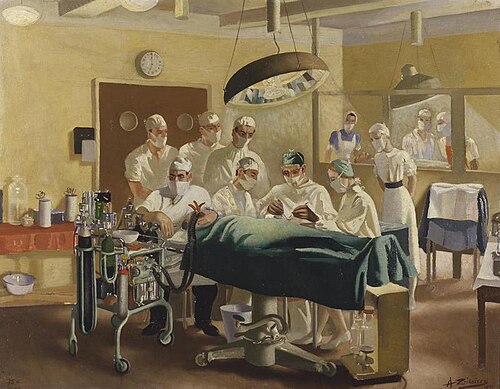
[McIndoe operating]
Not content with improvements in medical care, McIndoe realized that recovery was as much psychological as it was physical; social factors played an equally important role.MWith his encouragement, his patients formed the Guinea Pig Club, open to any patient who had undergone at least two operations at Queen Victoria, as well as the medical staff who treated them (McIndoe was elected life president). He insisted that his hospital ward be painted in cheerful colors, not drab hospital hues. He banned the use of special hospital uniforms (called “convalescent blues”)—he felt they made the wearer look like a criminal and made them feel sorry for themselves. Instead, the men were allowed to wear anything they chose—and most chose to proudly wear their RAF uniforms.
McIndoe went further. He encouraged politicians and celebrities to meet and socialize with the Guinea Pigs as a way of supporting the war effort. He also appealed to residents of East Grinstead to allow the Guinea Pigs into their lives.
And it worked.
Guinea Pigs became a regular sight at local shops and pubs (one of which changed its name to The Guinea Pig). Relationships flourished—many Guinea Pigs ended up marrying their nurses or local girls. East Grinstead soon acquired the label: “The Town That Didn’t Stare.”

[The wedding of Bill Foxley and Catherine Arkell at St. Swithun’s Church, East Grinstead, June 1947. McIndoe is in the rear, right. Bill and Catherine met while she worked at the hospital. On March 16, 1944, while completing his flight training, Foxley’s plane stalled and crashed. He escaped from the blazing aircraft unharmed, but returned to help another airman still in the plane, thereby suffering severe burns. He had already undergone at least 29 operations (some accounts mention 33) before the marriage. Foxley died on December 5, 2010. He was 87.]
In the five-and-a-half-year span of World War II, 4,500 airmen were treated at East Grinstead, of whom 200 required total reconstruction of hands and face.
Membership in the Guinea Pig Club eventually reached 649. Expected to disband at war’s end, the club continued to hold annual reunions until 2007. The last members of the club, Sam Gallop and Jan Stangryciuk-Black, died within days of each other in October, 2023, both age 101.
McIndoe was knighted in 1947 for his work at the Queen Victoria Hospital.
He died 66 years ago today, on April 11, 1960, age 59.
His legacy is carried on at the Blond McIndoe Research Foundation, established at Queen Victoria Hospital in 1961, which continues to conduct research into treatments to improve wound healing.
His ashes were buried at the Royal Air Force church of St. Clement Danes in London, the only civilian to be so honored.
And to the members of the Guinea Pig Club: You were all profiles in courage.

