“I believe it will be hard for posterity, indeed for other people at all, to grasp the depth of suffering and horror of which Auschwitz has been the frame. Still less will it be possible to understand those who have survived it. That they can remain human beings, think and feel like human beings. One can’t help but admire them.”
Odd Nansen’s diary, Monday, November 13, 1944
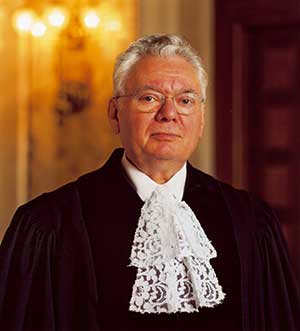
When I read those words of Odd Nansen, I immediately think of Tom Buergenthal, who passed away three years ago today, age 89.
For Tom survived life in the Kielce Ghetto, as well as its liquidation (25,000 of its 27,000 inhabitants murdered); survived a labor camp; survived the liquidation of the labor camp (all remaining children murdered); survived the Henryków work camp; survived life in Auschwitz-Birkenau; survived the Auschwitz death march; and survived (with Nansen’s help) Sachsenhausen.
Indeed, Tom had his entire childhood, from age 5 to age 11, stolen from him; exchanged for a life of constant peril, turmoil, and suffering.
And yet Tom not only remained a human being, he flourished. His Wikipedia biography describes him as an “international lawyer, scholar, law school dean, and judge of the International Court of Justice.” It also notes that he received numerous honorary degrees from American, European and Latin American universities, including the University of Heidelburg in Germany, the Free University of Brussels in Belgium, the State University of New York, the American University, the University of Minnesota and the George Washington University.
It is hard, nigh impossible, to imagine a more dismal childhood followed by a more illustrious adulthood.
One would think that, with so many accomplishments, and against such odds, Tom would develop a certain swagger, or at least an inflated self-regard. Many people have done far less and yet boast outsized egos. But not Tom.
In 2017, Tom wrote me an email which I have always cherished. While congratulating me on the roll-out of From Day to Day, Tom closed with these words: “All in all, I just want to tell you that I am delighted to know you and to count myself as your friend.” Tom didn’t write that he was happy I was his friend; rather it was that he was my friend.
If a single sentence can capture the essence of a person, to me this is it.
Tom, I miss your friendship, but will always remain inspired by you and your example, much as Odd Nansen was. RIP.