Happy Semiquincentennial!
That’s a mouthful, and no mistake. Naturally everyone has been focused lately on the 250th anniversary of the signing of the Declaration of Independence and the birth of America.
Not to take anything away from Independence Day, but there have been other important anniversaries lately which deserve some attention as well. Take the Battle of Bunker Hill for example, the 251st anniversary of which was observed this past June 17. Without the colonists’ willingness to fight for their rights on Bunker Hill, Independence Day would never have been possible.
My son Patrick, a ranger with the U.S. Park Service assigned to Boston National Historical Park, was recently asked to give some remarks at that anniversary, which were so interesting (IMHO) and universal in their application that I decided—with his permission—to reprint those remarks here. I hope you enjoy them.
“The Veterans’ Legacy of Bunker Hill”
Good afternoon, my name is Patrick Boyce and as a park ranger at Boston National Historical Park, I’ve interpreted this site for 11 years. Before I wore the National Park Service green and grey, my day-to-day uniform was the woodland or desert camouflage fatigues of the U.S. Marine Corps. I served as an infantry officer, military policeman, and public affairs officer in both Iraq and Afghanistan.
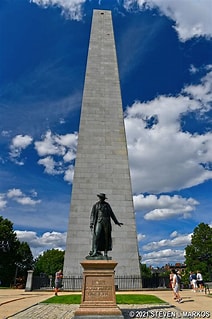
In 1843, the 11 surviving veterans of the Battle of Bunker Hill stood at this very spot to see the Bunker Hill Monument officially dedicated. They were but the first of many generations of veterans, which now includes myself and others here, who likewise have stood on this battlefield and paused to reflect on the service and sacrifice of those patriots of 1775.
The Battle of Bunker Hill has been commemorated here for two and a half centuries, and while there were many battles of the Revolutionary War, fought over an enormous geographical area, few other battles have been bestowed with an almost unbearable responsibility for the telling of a story of national origin and significance borne from a few violent minutes of musket fire. Therefore, it becomes difficult to talk about this battle without resorting to oft-repeated truisms; such as explaining that the Battle of Bunker Hill was actually fought on, as some knew it then, Breed’s Hill; or debating who actually said “don’t fire until you see the whites of their eyes” or whether it was even said at all; and concluding with the coda that despite the fact that the British troops won the day, colonial Americans inflicted more casualties, as though casualties alone dictated the outcome of continental wars.
These broad narratives and pieces of military trivia can often obfuscate the personal experiences of men like Peter Brown from Westford, Massachusetts or Jude Hall from Exeter, New Hampshire, who stood here on this ground, 251 years ago to the exact minute.
For both these young men, this was a battle fought at close range, muzzle to muzzle. Before June 17, 1775, most of the men here had never pointed a weapon at another human being and squeezed the trigger. Imagine for a moment standing in the ranks, whether on this hill or below it, anticipating the crashing volley fire of your opponent’s muskets and waiting in that awful moment of silence, before fate or your opponent’s aim determined how long or short your life would be. In that moment you would likely see in your peripheral vision the man to your left or the man to your right. Maybe they were a friend from your hometown that you had known since childhood; maybe a stranger from a different community, a different colony; or maybe even a different race than your own. You counted on this man to stand his ground and execute his duties, just as he was counting on you to do the same, men convincing each other that they were still brave, up until the roar of the guns. Then the only goal that mattered was to survive, survive the next moment, the next volley, the next charge. Survive 120 violent, crowded minutes.
Some men did not survive, while other lived to see the mid-19th Century. In the decades following the battle, how did veterans reflect on their experience here, or the legacy of their service? Only 11 lived to see this monument completed. You’ll notice of course that no names or dates are included on the granite obelisk. Instead, for some, the permanent legacy of their service must be found elsewhere.
Peter Brown, who survived the battle, finished his military service after eight months, and although he lived until the age of 76, this eight-month period of his life meant enough to be carved into his headstone, which states simply “he was a soldier in the revolution.” Would he, as a veteran who thrived in the last five decades of his life, enjoying the rights and responsibilities of a citizen of a new republic, been satisfied with this recognition of his service? I would think so.
Jude Hall, conversely, served for a total of seven years during the Revolutionary War. When he passed at the age of 80, his burial place in Exeter remained unmarked for centuries until a headstone was installed in the year 2000. It likewise memorialized the fact that Hall “fought at the Battle of Bunker Hill.” How might Hall have reflected as a veteran on his service in the twilight of his life? Unlike Peter Brown, Jude Hall was born as property, and he fought here while still enslaved. While he subsequently self-emancipated through valor and service, his own children were re-enslaved, never to be reunited with their father. When Hall applied for a military pension in 1818, nine years before his death, what would he have thought about this nation’s recognition of his service—what was his recompence as a veteran for his lost children?
For both men, however, it was not memorialization that motivated their service. What did, I think, is the same which is hoped for by veterans of any age and conflict: that their service and sacrifice is honored best, not by being petrified in stone, but by the laws, conduct and wise governance of the nation for which they fought. It is therefore the task of all citizens, whether veterans or not, to ensure that such a government lives up to the legacy of those who fought here. They fought for one another, for their homes and families, and for an ideal of freedom and equality unshackled from political, economic, and personal bondage. The legacy of the Revolution and its veterans is therefore a call to action that every American generation is duty-bound to listen for and respond to—let us be their legacy.