
The revised hardcover edition of From Day to Day was re-published exactly three years ago this week. I don’t think I ever realized the significance of this week in any of my previous reflections. Monday, April 22, represented the 74th anniversary of the liberation of Sachsenhausen, and with it, freedom after almost six years for Thomas Buergenthal. Similarly, April 27-28, 1945 represents the final entry in Nansen’s diary. Nansen’s agonized, brutally honest words from that entry, when he is on the cusp of freedom, are worth repeating:
“What on earth am I to write? It’s as impossible today as on all the other days that have passed in one long whirl of unreality and fairy tale. . .. The day before yesterday I was to scribble a message to Kari, only a hurried greeting, a few words on a scrap of paper, with the mudguard of a truck to write on. . .. But no, it seemed to me impossible, insuperable! . . . I felt like crying with despair and rage. . .. Dear, darling Kari! .. . . I don’t know what more I got down. I had to write something, couldn’t say I found it impossible. Only a little message—I’ll be soon be home! Surely I could write that much! And so I wrote that. . .. And here I am, as bankrupt, as confused, and as stupefied as ever, out of contact with reality, because it is in fact unbelievable.”
Anniversaries are also a time for stock-taking. Here are some of the highlights of my three-year journey (cumulative through 12/31/18):
Miles traveled: 51,807
Website visitors: 7,301
Presentation audiences: 5,000+
Presentations made: 137
Blogs written: 105
Speaking of blogs, several friends have wondered at the recent dearth of blogs from me. I can only plead a busy travel schedule, which has prevented me from collecting all my thoughts. But the travels have certainly been worthwhile. The following represents just a few of the highlights in the first quarter of 2019, (but which nevertheless are emblematic of the entire experience with this book since the start):
- Before speaking at the Providence Athenaeum in February I was shown the library’s rare book collection, which is rare indeed: a first edition, signed copy of Walt Whitman’s Leaves of Grass, a first edition Moby Dick, and a library charge-out book signed by library patron “E.A. Poe.”
- In Barrington, RI, an audience member that his own grandfather had spent time in Grini, the Norwegian camp where Nansen spent almost 18 months.
- In Baltimore, I met a 92 year-old patron named Joel. Joel returned to the room where I had spoken just as I was packing up to leave. He told me that my recitation of Nansen’s diary entry for August 27, 1944, wherein he relates that his love for Kari is of eternity, and will never die “even though we should never meet again,” had struck a nerve with him. Joel explained that he fought in the Italian campaign during WWII, and had lost a brother in the Battle of the Bulge, and had another brother injured in the same battle. With tears in his eyes, he confessed that while fighting in Italy he never thought he would make it home alive himself. Joel then confessed that, until that very day, he had never mentioned this crippling fear to anyone else in his entire life.
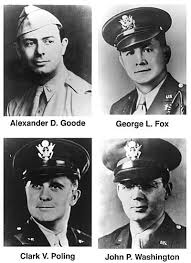
- In York, PA, I learned about the famed “Four Chaplains,” sometimes also known as the “Dorchester Chaplains.” Four chaplains (Alexander Goode, a rabbi; John Washington, a Catholic priest; George Fox, a Methodist minister; and Clark Poling, a Reformed Church minister) were sailing with the troop transport SS Dorchester when it was torpedoed on February 3, 1943. When the supply of life jackets ran out, each of the chaplains gave his away, and remained with those unable to escape the sinking ship. The Dorchester sank in 27 minutes, with 672 men still on board. The four chaplains were last seen on deck, arms linked, praying together. The town of York, where Alexander Goode once served as a rabbi and scout leader, commemorates the memory of the Four Chaplains with a prayer breakfast annually around mid-May, close to Rabbi Goode’s birthday of May 10.

- In Milwaukee, a guest brought with her a framed photo from Life Magazine showing the liberation of Dachau [which incidentally occurred April 29, 1945–another April anniversary]. The photo shows four GIs at Dachau’s gate. The one with the cigarette in his mouth was her brother.
- In Lincolnwood, IL, I met a relative of Michael Bornstein, probably the youngest survivor of Auschwitz, and I learned about his moving memoir, Survivor’s Club—I highly recommend it.
- Finally, in Lisle, IL, I met Margaret Roth, a survivor of a different sort. She was born in Germany in 1938 and grew up in the shadow of the war, emigrating to the U.S. in 1968. She inscribed her family memoir, An Ordinary Family in Extraordinary Times, to me as follows: “To Timothy Boyce/For a wonderful talk that showed that human love and compassion can overcome the greatest evil.”
On that positive note, I am excited to begin the fourth year of From Day to Day’s new lease on life, and see what fresh developments and experiences the next 12 months will bring.

