
Eighty-six years ago today, the lights were switched on for the first time in Great Britain’s so-called Cabinet War Rooms, now more familiarly referred to as Churchill’s War Rooms.
They would not be switched off for another six years.
In the lead-up to World War II, it became increasingly apparent to the British Government that, with the advent of the long-range bomber, a secure, underground “war room” would be needed as a safe haven, enabling Britain’s political and military leaders to direct the war effort from a single location. The only glitch: a new, purposely built facility would take up to four years to complete—far too long a period of vulnerability. In the alternative, and in what was billed as a “temporary, emergency expedient only,” the authorities searched for an existing facility that could be quickly retrofitted to serve their purposes. That search ended in the basement of the New Public Offices, located on the corner of Horse Guards Road and Great George Road, London, close to 10 Downing Street and Parliament.
What should this new underground facility look like? No one knew—the whole concept of a centralized war-making facility was without precedent—a first of its kind. Accordingly, the War Rooms would change and adapt as the war unfolded.
Work began in June 1938. As noted, the facility became fully operational, and the lights switched on, for the first time on August 27, 1939. The timing was auspicious—four days after Hitler and Stalin had signed a nonaggression pact, leaving Germany free to invade Poland, and one week before Britain formally declared war on Germany.
The purpose of the War Rooms was two-fold: 1) to gather and disseminate intelligence about the war’s progress and 2) provide a protected meeting place for the War Cabinet and military Chiefs of Staff in air raid conditions.
From day one, the first key function was fulfilled by the Map Room. Here, every development in every theater of the war was presented on maps manned 24 hours a day, 7 days a week. It was also from here that daily intelligence summaries were prepared and disseminated to the Prime Minister, the Chiefs of Staff, and the King.
The Map Room:
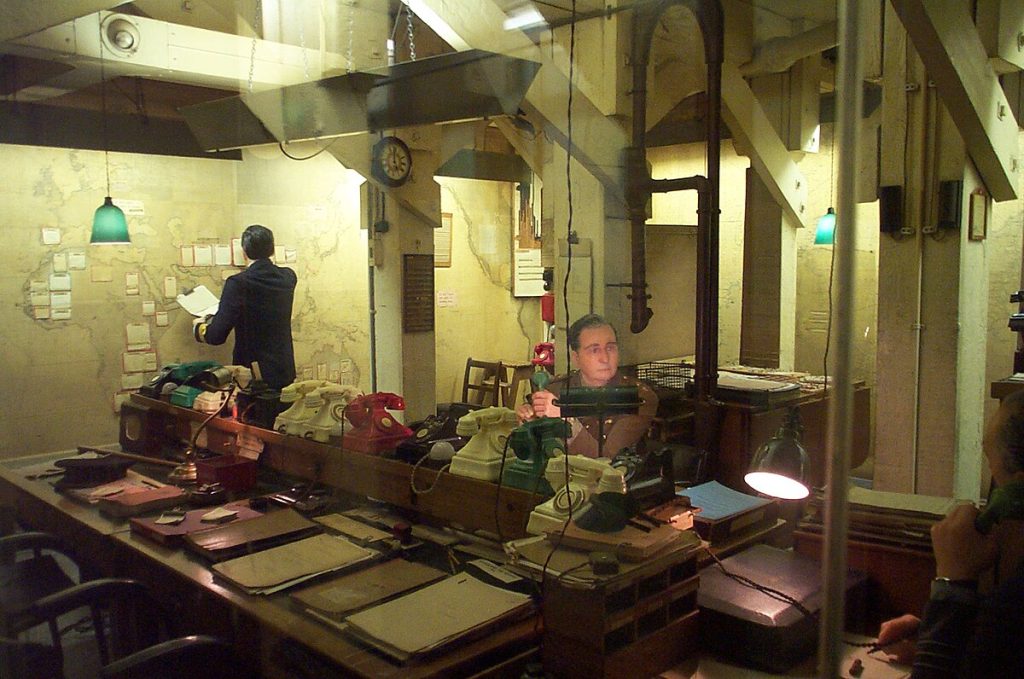
The second function was embodied in the Cabinet Room. A first test meeting of the War Cabinet in the underground shelter was held on October 21, 1939. As there were no air raids directed at London at the time, the War Cabinet continued to regularly meet above ground, at Parliament or Downing Street.
All that changed on September 7, 1940—the start of the Blitz: a sustained air attack on London that would last for the next nine months. It was not until the following Spring (the last heavy raid was on May 10, 1941), when Germany turned its attention to invading Russia, that London was finally spared further destruction. Accordingly, the War Cabinet met underground only five times in 1942 and only twice in 1943. Although Churchill recognized the necessity of the subterranean War Rooms, he much preferred to be topside, watching all the action. He is believed to have spent only a handful of nights in his War Rooms bed, and ate not at all in the dining room reserved for him and his wife.
The Cabinet Room:
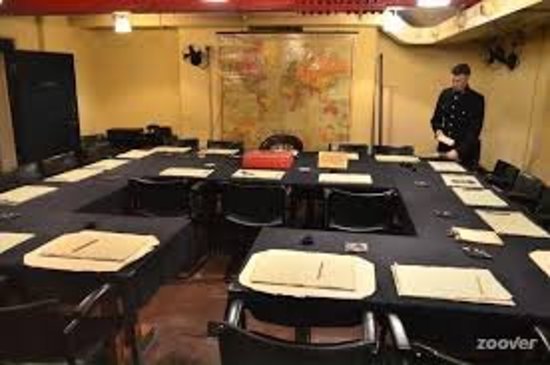
In mid-June 1944, with the advent of the V-1 flying bombs, the War Cabinet was forced underground again, a threat that continued until early September. The arrival in London of the V-2 rockets forced the War Cabinet underground on January 9, 1945 for yet a third time, until March 28, 1945, by which time most launch sites for the V-2 had either been captured or destroyed by the Allies.
All told, 115 War Cabinet meetings were held underground, out of a total of 1,188 meetings held over the course of the entire war.
On August 15, 1945, Japan surrendered and World War II ended. The very next day the lights in the Map Room and throughout the War Rooms were turned off, and the offices vacated. Miraculously, these rooms would be left relatively untouched for years thereafter.
As World War II receded into memory, small groups were allowed into the space, to see “where it all happened,” but the space was still not open to the general public. It was not until April 4, 1984 that the War Rooms, fully restored and operated under the auspices of the Imperial War Museum, were formally opened to the public.
Today the site attracts hundreds of thousands of visitors annually.
Earlier this month, my wife and I, on a Rick Steves tour of England and Wales, had the good fortune to visit the War Rooms. One is immediately struck by the sheer dedication with which its many occupants, from Churchill and his generals down to the lowliest typist and armed guard, working cheek by jowl in cramped, primitive, and barely livable spaces, in utmost secrecy and under enormous pressure, fulfilled their daily tasks and saw Britain and the Allies through to victory.


