
The following tribute was not written on Father’s Day, nor was it intended for Father’s Day.
It was written on December 7, 1944—the anniversary of Pearl Harbor—by a 21 year-old Marine to his father back home in the States.
The Marine was James W. Johnston. Long after the war, at age 76, Johnston wrote of his combat experience in The Long Road of War, to my mind one of the finest memoirs ever written about World War II—and there are plenty of outstanding ones.
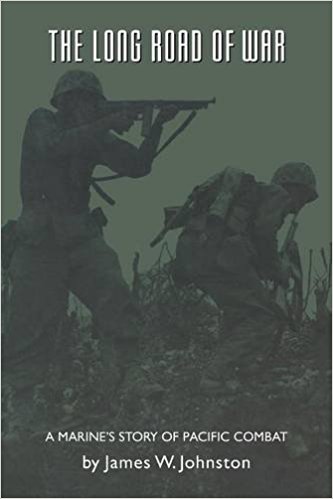
After reading the book back in 2006, I contacted Johnston, and had the pleasure and honor of speaking with him several times before he died on March 27, 2009. Jim was always gracious with his time, and very solicitous of my two sons, then both serving in the Marines.
He explained to me that he was a “flat-trajectory Marine,” a phrase I had never encountered before. By that he meant that he did not fire artillery at targets way off in the distance, or lob mortar shells from behind the front lines. No, he was shooting directly at the enemy, who was firing directly at him, trying to kill him.
When Johnston wrote the lines cited below to his Dad, he was only 21, but a boy no longer. He had already participated in three bloody campaigns: Eastern New Guinea, New Britain and Peleliu.
By December 1944 he was resting, and recuperating, on the South Pacific island of Pavuvu, awaiting troop replacements (“to fill the voids left by Peleliu”) and gear before undertaking the invasion of Okinawa—one of the longest, deadliest and most savage Marine campaigns of the war, or of any war (up to 160,000 combined combat casualties; over 400 Allied ships sunk or damaged; up to one-half of the island’s civilian population of 300,000 killed). Johnston’s machine gun squad, which he had just been promoted to lead, was part of the first assault wave. [According to the Marine Corps Gazette, “More mental health issues arose from the Battle of Okinawa than any other battle in the Pacific during World War II.”]
Before the war was ended, Johnson would receive the Combat Action Ribbon, two Purple Hearts (Peleliu and Okinawa), and a Navy Commendation Medal.
As the father of two former Marines (both of whom also received the Combat Action Ribbon, as well as Navy and Marine Corps Achievement and Commendation Medals), I find Jim Johnston’s words to his father, in their simplicity, their unabashed affection, to be particularly poignant, and they have stuck with me for years. Here’s what he wrote:
“This is December seventh. Do you remember three years ago today? We were riding home in the car and we had heard all about Pearl Harbor. Somewhere between McCook and Wauneta [Nebraska] we heard La Paloma [on the radio]* and, Dad, you said, ‘Son, we may be separated many miles some of these days but wherever you are and no matter how far separated we are when you hear that song, think of your old Dad.’
Three years have passed since that day and two of them we have been separated these thousands of miles. I don’t have much opportunity to hear that piece. Most of the time I can’t even hear any music and when I can hear some, I can’t request what I want; but Pop, right now I’m hearing La Paloma, and do you know why?—because I’m whistling it.”
Happy Father’s Day to all, and especially to those fathers who have sons or daughters in harm’s way, whether on land, at sea, or in the air.
[* Historical Note: it is likely that Johnston and his Dad were listening to the Harry James version, which was recorded by Columbia Records in 1941.]

