Seeing as how today marks the 250th anniversary of the British march on Lexington and Concord, I thought I’d leave World War II and the Holocaust alone for today and focus on the American Revolution.
The older I get, the more amazed I am at the longevity of our Founding Fathers. Without vitamins, supplements, prescription drugs, antibiotics, vaccines, hospitals, or even many physicians (and even fewer worthy of that title—the remedy for all ailments then were purgatives and bleeding), many of our founding generation nonetheless lived until a ripe old age. Add to that: no indoor plumbing, no electricity, no central heating, and few labor-saving devices (other than animals). I know that infant mortality was high, and that many women died in childbirth, but the fact that anyone could live an active life into their 90s in such an environment is simply beyond my comprehension.
Any yet they did. (Then again, they did not have to contend with microplastics, pesticides or smog, among many other “benefits” of civilization.)
John Adams lived until he was 90; Jefferson until he was 83. (They both died the same day, July 4, 1826). Franklin lasted until age 84. Of the 56 signers of the Declaration of Independence, exactly one-half lived to be over 60, 14 to be over 80. Our first president, George Washington (who did not sign the Declaration) only lived until age 67, but had to endure the entire Revolutionary War in the field so to speak—not once returning to his home at Mount Vernon. (Wife Martha did visit him in his winter quarters when campaigning typically ceased.)
Two years ago today, my son Patrick, Patrick’s friend, and I decided to follow in the footsteps of the British in their march to Lexington and Concord. Setting off from Boston at 1:30AM, as did the British, we reached Lexington Green around 4:30AM, again as they once did, and arrived in Concord around 8:00AM. Instead of firing the “shot heard round the world,” in the words of Ralph Waldo Emerson, we ate a hearty breakfast, and began the return trek. We reached Charlestown by dinnertime, having covered 40 miles, weary, but proud that we could relive in some small way the events of centuries past.
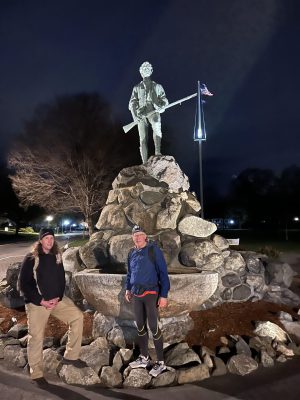
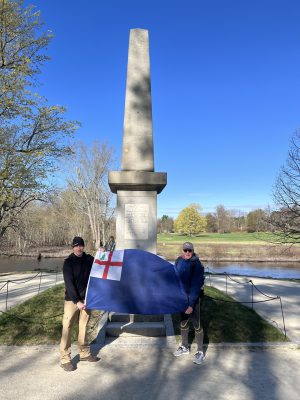
Along our march we came upon many historical markers, plaques, signs, monuments, etc., all commemorating the events of April 15, 1775.
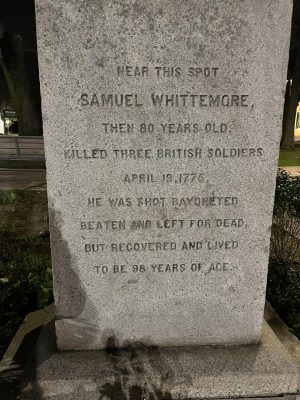
One such monument relates the story of Samuel Whittemore, the oldest known combatant in the American Revolution. Born in 1696, Whittemore was 78 years old at the time, living in Arlington, Massachusetts (then called Menotomy) with his wife, son, and grandchildren.
As the British marched through town in the early morning hours of April 19, Samuel’s wife made plans to flee to the safety in another son’s house in nearby Medford. She of course presumed that Samuel would accompany her in her plan. She learned she was mistaken when she found him oiling his musket and two pistols and sharpening his sword.
As the British retreated along the same route in the afternoon, now under constant harassment from the local militia, Whittemore took up a position behind a stone wall and waited. He killed his first grenadier with his musket, and felled another two with each of his pistols. By then a British flanking party had reached his position so he drew his sword. A British musket ball struck him in the head, knocking him unconscious. It was thus easy for the grenadiers to club him with their muskets and stab him with their bayonets, leaving him for dead in a pool of blood.
Once the British had passed, Whittemore’s body was carried to a nearby tavern and a doctor summoned. His medical judgement: hopeless. With at least 17 bayonet wounds the patient would soon be dead.
But Samuel Whittemore proved the doctor wrong.
Not only did Whittemore survive his wounds, he lived another 18 years, finally dying “of natural causes” at age 96.
Although the American Revolution was just getting underway, with colonists like Samuel Whittemore the Brits had no chance.