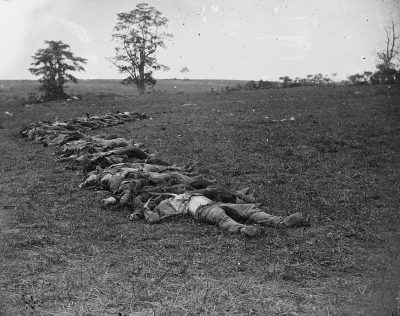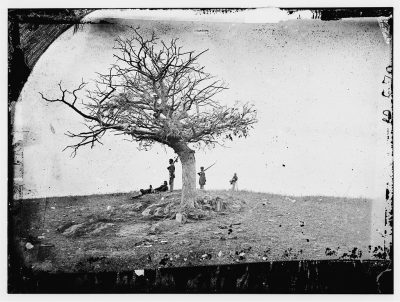
Today marks the 161st anniversary of the Battle of Antietam, the bloodiest day in American military history. More Americans were killed or wounded—22,717–in a single day, September 17, 1862, than on any other day in any other war America has fought.
General George B. McClelland, the ever-cautious, ever-methodical commander of the Union Army of the Potomac failed, despite numerous opportunities, to inflict a crushing blow upon General Robert E. Lee’s Army of Northern Virginia. He did, however, force Lee to abandon his incipient invasion of Pennsylvania, and return to northern Virginia. In that sense Antietam can be considered a slight military victory for Union forces.
The larger significance of Antietam, however, derives from more than the military outcome alone.
By early September 1862, President Abraham Lincoln had concluded that the war needed to be fought, not just to preserve the Union, but to end slavery in America once and for all. Lincoln concluded, however, that such a monumental move could only be implemented when the North had seized the initiative in the war. As historian Bruce Catton explains in Mr. Lincoln’s Army, the first volume in his Army of the Potomac trilogy (recently re-released by the Library of America):
“[A]s things stood just then he [Lincoln] could not issue it. [Secretary of State William] Seward had warned him: Put that out now, when we have been defeated [at First Bull Run; Peninsula Campaign; Second Bull Run] and our armies are in retreat, and it will look like a shriek of despair—not an attempt to help the black race, but an appeal to the black race to help us. We must have a victory first.”
Antietam gave Lincoln this opportunity, as Catton eloquently concludes:
“Yet it was finally, and irrevocably, the decisive battle of the war, affecting the whole course of American history ever since. For this stalemated battle—this great whirlwind of flame and torn earth and shaking sound, which seemed to consume everything and create nothing—brought about the Emancipation Proclamation and put the country on a new course from which there could be no turning back. Here at last was the sounding forth of the bugle that would never call retreat.”
The preliminary Emancipation Proclamation was issued five days later, on September 22, 1862.
Some of the scenes from the battle are nothing short of tragic. One regiment, the 16th Connecticut, had been mustered into the army only three weeks earlier. Its soldiers had loaded their muskets for the very first time only the evening before; during the battle it was ordered to maneuver as a regiment for the first time, and do it while under fire. “The grand and picturesque business of charging a rebel line, which had sounded so impressive and inspiring back home, had come down to this—hiding in cornfield and being shot at by people who were completely out of sight.”
The astounding loss of life at Antietam, and indeed, the prodigious casualties experienced throughout the Civil War (more than all the casualties suffered by America in all other wars combined) perhaps explains the attraction of a poem entitled “Mortality,” which was said to be President Lincoln’s favorite poem.
Composed by Scottish poet William Knox (1789–1825), it is said that Lincoln could recite the entire work from memory. It was widely reprinted following his assassination. The full poem runs eight stanzas (and can be found here). The first and last stanzas read as follows:
“O, why should the spirit of mortal be proud?/Like a swift-fleeting meteor, a fast-flying cloud/A flash of the lightning, a break in the wave/Man passes from life to his rest in the grave.
‘Tis the wink of an eye, ‘tis the draught of a breath/From the blossoms of health, to the paleness of death/From the gilded saloon, to the bier and the shroud/O, why should the spirit of mortal be proud?”