
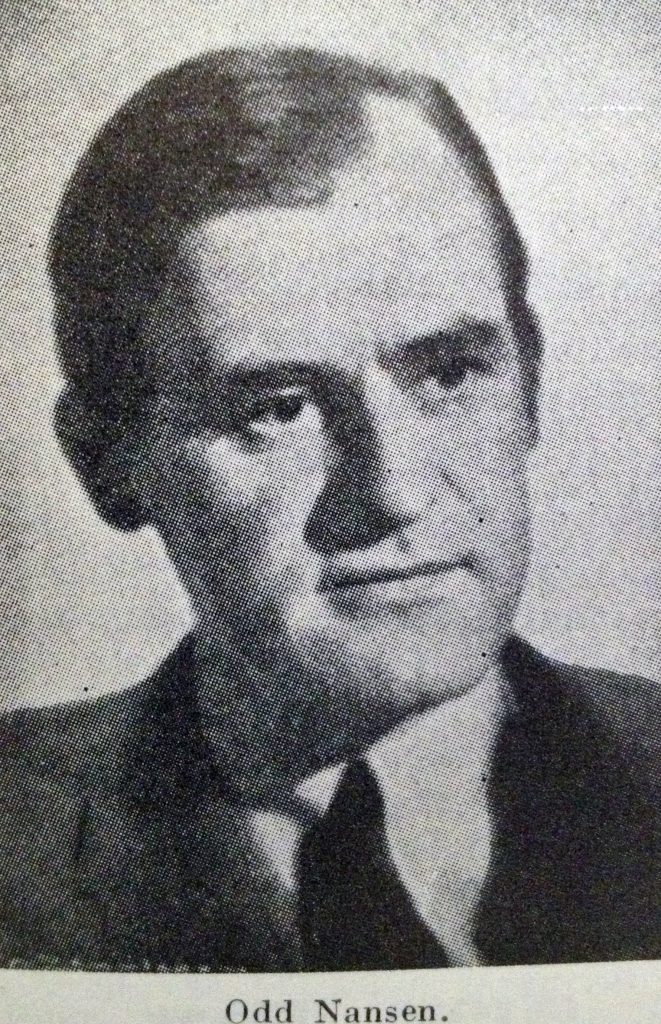
Odd Nansen died 44 years ago yesterday, on June 27, 1973, age 71.
In a fascinating, insightful and highly readable new book, Why: Explaining the Holocaust, author Peter Hayes concludes his inquiry with three “broad implications for all citizens.” Second among these is that “the Holocaust illustrates the fundamental importance and difficulty of individual courage and imagination.” Certainly, Odd Nansen possessed the requisite courage and imagination. But Hayes goes on to remark that bravery alone is not enough: “wit, wiliness, shrewd judgment, persistence, and creativity in challenging evil are also indispensable.” Again, Nansen’s diary is replete with examples of these traits as well.
Hayes’ book is broken into a series of chapters, each of which addresses one question central to the Holocaust: Why the Jews? Why the Germans? Why murder? Etc. One question Hayes does not tackle (probably because it would require its own book) is why some people became villains, and yet others, like Nansen, became heroes.
When we pontificate today that “we must never forget the Holocaust” or “we must never let it happen again,” implicit in our statement is the firm belief that we would never participate in such evil; we would never support a program like the Nazis. And yet millions of Germans, Austrians, and Sudeten Czechs joined the Nazi Party, and millions more collaborated with them in occupied and allied countries.
Perhaps—perhaps—one can understand the allure which the Nazi ideology (and jobs) held for the down-and-out mechanic or the failed farmer (which is what Heinrich Himmler, the greatest mass murderer of all time, was before the war).
But how could educated German doctors, subject to the Hippocratic Oath (“do no harm”), willingly engage in the so-called T4, or Euthanasia Action, killing the disabled (71,000–80,000 murdered by August 1941, and many more after that as well)? How could “many eager lawyers,” dedicated to the rule of law, willingly act “as middleman in the sale of Jews’ assets, and the numerous willing graspers for their medical and legal practices, their artwork, their houses and apartments, their furniture and carpets”? How could German professors, leading some of the most prestigious academic institutions in the world, permit the Nazi minister of education to order them: “From now on, it is not up to you to decide whether something is true, but whether it is in the interests of the National Socialist Revolution”?
So, how could we have withstood the subtle coercion exercised by, and the enticing blandishments offered by, the Nazis had we lived in that time and place?
Hayes does provide a significant clue, when he writes, “Resistance is never easy and seldom comfortable, and compassion has to be practiced in order to hold up when challenged.” (emphasis mine). The Odd Nansen depicted in his diary (1942–1945) is the same Odd Nansen who voluntarily put his career on hold in 1936 to form a relief organization for stateless Jewish refugees. He undertook the task knowing it would be difficult, frustrating and often daunting, especially in the face of indifference and official governmental anti-Semitism. Is it surprising, then, that Nansen managed to survive the crucible of World War II with his humanity intact?
If today we flatter ourselves that we can be indifferent to suffering in our midst, if we can ignore the plight of those less fortunate, or of powerless minorities (like the Jews of the 1930s), if we can turn our backs on the lessons of the beatitudes, will we really be ready, if and when we are ever tested in a conflict as horrible as the Holocaust? The lessons of history say otherwise.

