
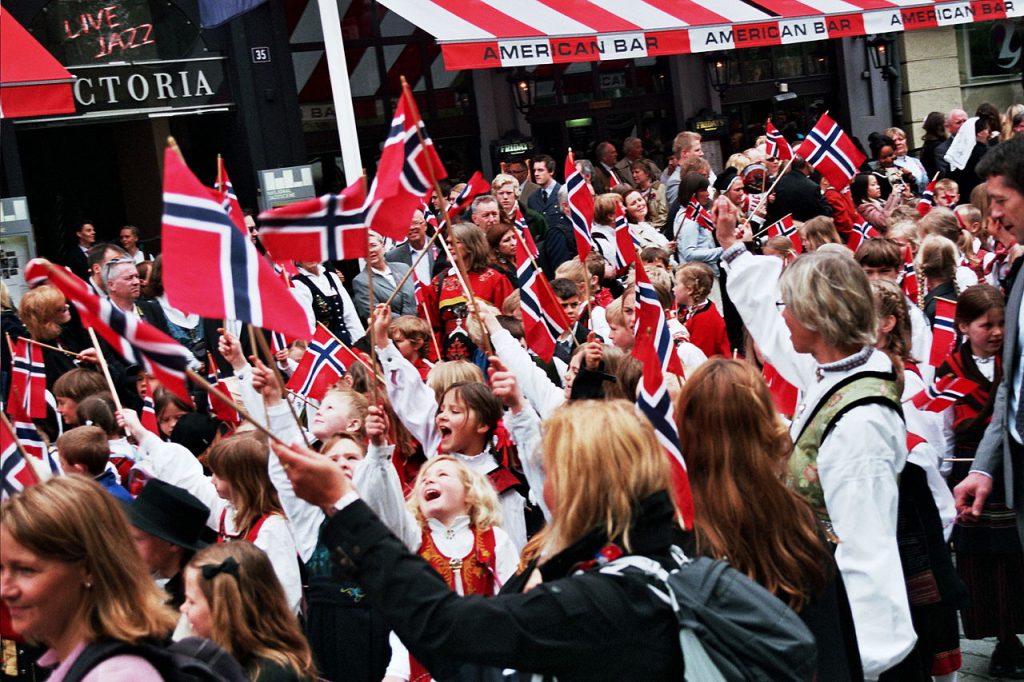
Syttende Mai, or May 17, is Norway’s Constitution Day, and its most important national holiday. Norwegians everywhere celebrate the signing of the Norwegian Constitution on May 17, 1814, by the Norwegian Constituent Assembly in Eidsvoll, Norway. The Norwegian Constitution is now the second oldest in continuous force (after the United States).
I can’t think of a better way to observe the day than to quote Odd Nansen’s own words written 77 years ago:
“Sunday, May 17, 1942
It’s best to forget the 17th of May when you are a Norwegian shut up in a German concentration camp and struggling to make the time vanish, so that it may be the 18th as quickly as possible. So in a way it was no bad thing to have a working day today. But work as I might, and struggle as I might to get the time, the confounded time, to pass, it wasn’t possible to forget that it was May 17th. It was in the air, the clear, fresh spring air blowing from the southwest. The sun shone from early morning; the birds were singing, the birches sprouting so that one could absolutely stand and watch how their pale green tops became denser and more copious hour by hour. They flamed against the dark wood behind, which hasn’t rightly awakened yet.
Southward the landscape opens out; there is no dark, grave forest barrier. The sallows too are beginning to dress for the party, as they stand by the spring becks winding down between the fields toward the sea—far, far out yonder. I truly believe we can make out a streak of that too, a silver streak just under the light blue ridge on the horizon. And the mind goes on to seek the glittering fjord, with its islands one behind another, right out to the last skerries and then still farther out, to the open sea.
And behind rises the blue landscape, up from the ocean and from ridge to ridge with green floes in among them, and with dark and light brown fields like patchwork between the copses and rocky outcrops, and at the back of all, the mountains stand against the spring sky, pale blue with shining flecks of white. It is as though the eye were following the mind upon its free journey. And one sails on along the coast, gazing in rapture at the wonderland within. A rush of warmth goes through one. This is all Norway. . . .
That is the content of the 17th of May; so it has always been, and so it will always be. No one can change it, least of all these Germans, who have no conception of it.
And no one can deprive me of today’s tour of Norway; I’ve been round the whole country and absorbed it with the spring air. I saw it bathed in spring sunshine, beautiful as never before. No, I take it back that one should forget the 17th of May because one’s in a German concentration camp. On the contrary, one should remember it and keep it more intensely and fervently than ever.”
Skål, Norway!
*By [email protected] – Own work, Public Domain, https://commons.wikimedia.org/w/index.php?curid=10407995

