
On this date in 1942, Chief of the OKW [High Command of the German Armed Forces] General Wilhelm Keitel, at Hitler’s insistence, issues the top-secret Commando Order. In essence, the Order directed that any enemy soldier involved in sabotage or commando-type activities was to be summarily executed without trial—even if the soldier was in proper uniform and even if the soldier attempted to surrender.
Since this directive flew in the face of the Geneva and Hague Conventions (to which Germany was a party), which held that any enemy soldier captured while in uniform was to be considered a prisoner of war (POW) and treated accordingly, the Commando Order was issued in secret. Only a dozen copies were distributed by General Alfred Jodl, Chief of Operations Staff, the following day, with instructions that the Order was intended only for commanders, and must not fall into enemy hands under any circumstances. Moreover, failure to carry out the directive would subject the offending commander or officer to miliary justice.
Who were among the first victims of the Commando Order?
Those of you who have heard my lecture: “The Heavy Water War: Stopping Hitler’s Atomic Bomb,” know that on the night of November 19, 1942—or roughly one month following the Commando Order—thirty-four highly trained British soldiers of the SOE (Special Operations Executive) were ferried to Norway in two gliders (15 men plus two pilots per glider) for Operation Freshman.
Operation Freshman called for the two gliders to be brought by their tow planes (using homing devices set out by a receiving team previously inserted into Norway) to a safe landing area. This location would be close by an industrial complex called Vemork located in Rjukan, Norway. Vemork was the site of the only heavy water production facility in the world. Heavy water, a rare variant of the water molecule (H2O) had recently been identified as a key component in the development of an atomic reactor, and potentially, an atomic bomb. It was the SOE’s mission to prevent the delivery of heavy water to Germany.
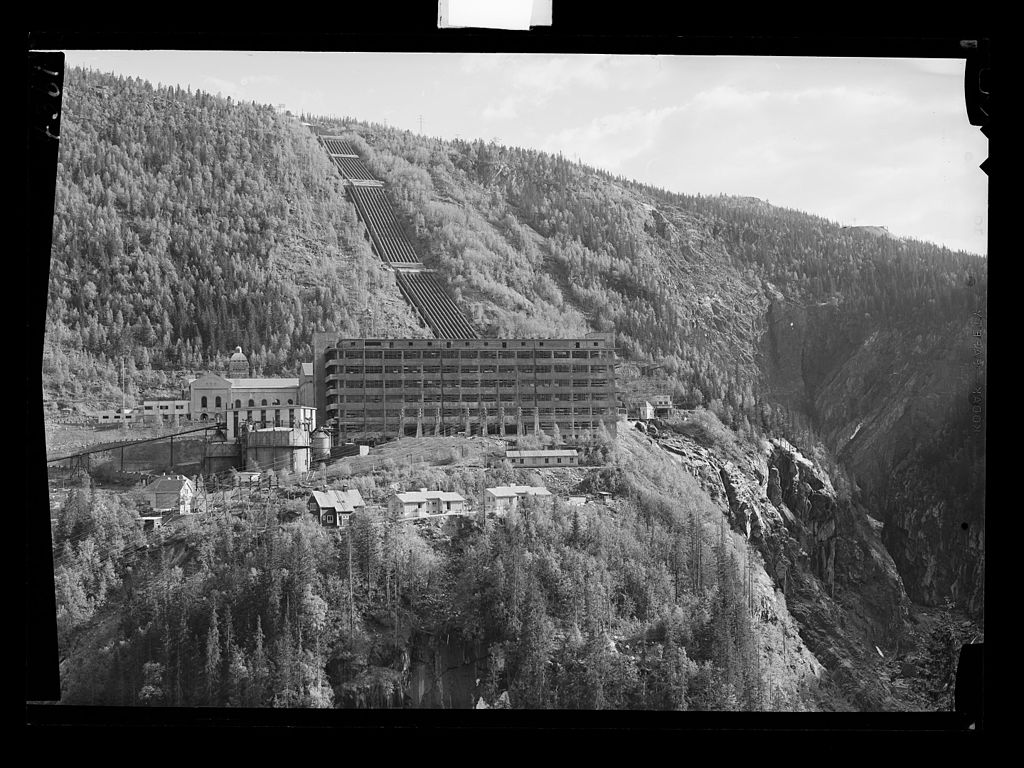
Vemork
If all went according to plan, the gliders, once safely landed, would disgorge their commando teams, hook up with the receiving team already on the ground, be guided to the heavy water facility, fight their way into the facility, and destroy it. (It was believed that a minimum of 15 demolition experts would be necessary for this task, and an initial team of 30 ensured that the mission would succeed even with 50% casualties.) Once destroyed, the surviving commandos were to attempt an overland escape to nearby, and neutral, Sweden. Even if captured, the Freshman team could take some comfort that their British uniforms would ensure their proper treatment as POWS, where they would presumably sit out the remainder of the war.
That, at least, was the plan.
The operation did not go as planned.
First, the homing devices proved defective. Moreover, the weather was not cooperating. Rather than clear skies and a full moon optimally providing some measure of visibility, the tow planes and their attached gliders ran into precipitation, which, at their altitude, formed ice on the tow planes, the tow rope, and the gliders, adding to their weight. Under these conditions the brittle tow ropes snapped, finally forcing the plunging gliders to make emergency landings in total darkness (Norway then being under blackout orders). Both crashes resulted in several deaths, as well as a number of serious injuries.
Faced with these circumstances, the able-bodied survivors sought out help from nearby Norwegian farmers, knowing that German forces would soon descend on their respective sites.
The German ultimately arrived, and, in accordance with the Commando Order, all surviving inhabitants of both gliders were soon murdered. [For good measure, one of the two tow planes also crashed into the side of a mountain shortly after its glider had disengaged, instantly killing the entire crew. After several further attempts to disrupt delivery of heavy water to Germany, the SOE, with the help of local resistance fighters, was able to put the entire heavy water apparatus out of commission in February, 1944.]
At the Nuremberg Trials both Generals Keitel and Jodl were found guilty of a number of war crimes, including their involvement with the Commando Order, and were sentenced to death. General Keitel’s request for a military execution (by firing squad) was denied; both he and Jodl were hanged on October 16, 1946, almost four years to the day after the Commando Order had been issued. General Nikolas von Falkenhorst, responsible for the execution of the Operation Freshman crews, was also sentenced to death, a sentence that was later commuted to twenty years imprisonment. He was released only seven years later, on account of ill health, but nevertheless lived on for another 13 years before dying in 1968.
Serendipity
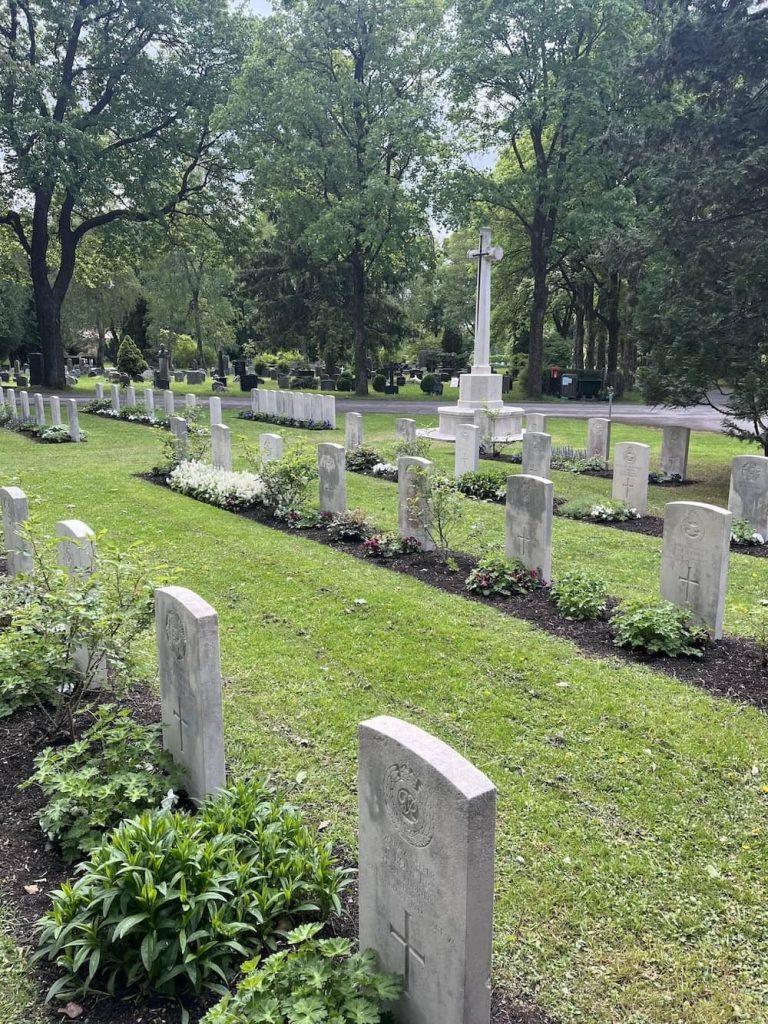
British gravestones
This past May, while on a lecture trip to Norway, Odd Nansen’s granddaughter Anne and husband Preben were kind enough to take me to Oslo’s Vestre Gravlund Cemetery, where there is a section dedicated to British soldiers, sailors, and airmen who died in Norway during World War II. Five of these dead were members of Operation Freshman.
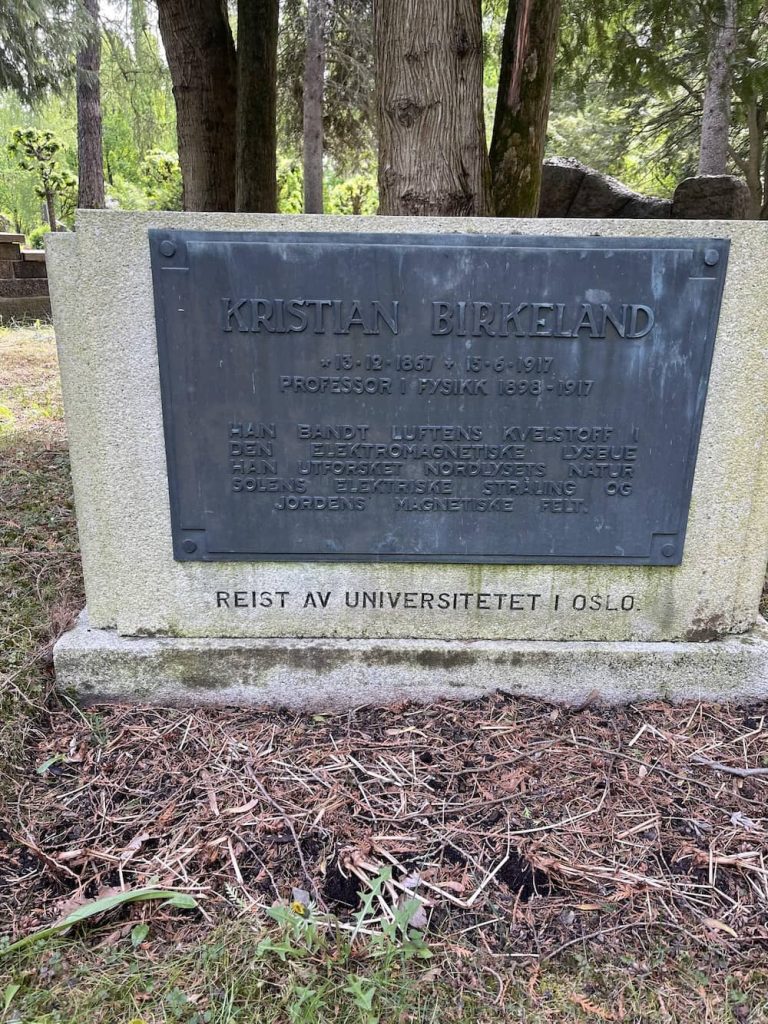
Birkeland’s gravestone
As we continued to walk through the cemetery, I soon happened upon another gravesite, not more than 20 or 30 yards away, this one for Kristian Birkeland. A scientist and professor of physics, it was Birkeland’s discovery, around 1905, of a method to “fix” nitrogen and thereby produce artificial fertilizer, that led to the construction of the Vemork facility (1906-1911) in the first place. Without Birkeland, there would have been no Vemork; without Vemork, there would have been no heavy water; without heavy water, there would have been no Operation Freshman; without Operation Freshman, the Commando Order would never have been applied to the captured British soldiers—volunteers all.
Another of the tragic “what ifs” of World War II.

