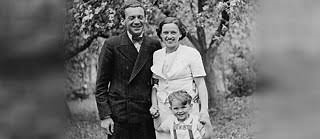
“The day before yesterday eight thousand fresh prisoners arrived in camp. On that account we’ve had to move still closer together. It’s impossible for more than half, at the highest estimate, to sit down to meals, and I daren’t even think how much air we have at our disposal per head. I’ll work it out someday.”
—Odd Nansen’s diary, Wednesday, November 1, 1944
Did Odd Nansen ever meet Tommy’s father, Mundek?
According to Tom Buergenthal’s memoir, A Lucky Child, his father Mundek arrived in Sachsenhausen on October 26, 1944, 81 years ago today. Odd Nansen’s diary entry of November 1, quoted above, refers to “the day before yesterday,” or October 30, 1944. Given the closeness in the two dates, the size of the transport Nansen mentions, and the fact that Auschwitz had begun to transport prisoners to camps in Germany in the face of the approaching Red Army, a process completed by January 26, 1945, it is possible to conclude that Nansen’s diary entry refers to Mundek’s arrival in Sachsenhausen. [It is also possible that October 26 refers to the date the transport left Auschwitz, rather than the date it arrived in Sachsenhausen.]
Even if the two above events are unrelated, it is indisputable that Mundek Buergenthal arrived in Sachsenhausen in late October 1944, stayed but a few weeks, and was then sent to Ohrdruf-Nord, a subcamp of Buchenwald, where he died on January 15, 1945, from pneumonia.
During those three weeks that Mundek was in Sachsenhausen could Odd and Mundek have met? Did they talk to each other (Odd was fluent in German, as was Mundek)? Did they nod in passing? Lock eyes for a moment? In a camp the size of Sachsenhausen, this all seems a bit unlikely, but as Nansen was known to intentionally visit the so-called Jewish barracks, and given how small in area Sachsenhausen actually is (I’ve walked the grounds, and they are cramped) it’s not impossible that Odd and Mundek came into contact—no more unlikely than Odd coming across young Tommy Buergenthal in Revier III in early February 1945.
The supreme irony is that Tom Buergenthal would never have thought to ask Odd Nansen if he had ever met (or seen) his father.
Why?
Because Tom labored—for decades—under the illusion that his father had actually been sent, not to Sachsenhausen, but to another concentration camp—Flossenbürg—where he had been murdered by the Nazis in the final days of the war.
When Tom initially published his memoir, A Lucky Child, in hardcover, in April 2009, he described his miraculous meeting with his mother in Göttingen, Germany in late December, 1949, after a separation of over two years. After having been liberated from Ravensbrück at war’s end, Tommy’s mother Gerda made her way to Kielce, Poland, where the family had once lived in the Kielce Ghetto, and where Tom’s parents had agreed they would return if they survived the war. At Kielce, Gerda “soon learned from other survivors that after my father and I had been separated in Auschwitz, he was sent to Flossenbürg and had died there shortly before the end of the war. . . . [A]s more and more survivors returned to Kielce and confirmed the news of his death, she had no choice but to accept it.”
Unfortunately, that news was incorrect.
As Tom writes in the revised paperback edition of his memoir of 2015: “It took almost seventy years after the end of the Second World War for me to learn the moving details of . . . the events that led to my father’s death.”
Those details were to be found in documents maintained by the International Tracing Service (ITS), “an archive like no other” administered by the International Committee of the Red Cross and located in Bad Arolsen, Germany. According to Tom, “for more than sixty years those documents were not generally accessible, neither to survivors nor to the relatives of those who had perished and who sought information about the fate of their loved ones.” Only when this “cruel and inexcusable policy was finally reversed,” could Tom finally learn the truth about his father. He related all this new information in an Afterword that was added to the 2015 paperback edition of A Lucky Child.
Unfortunately, by then Tom’s mother was already dead, having passed away in 1991.
So, too, was Odd Nansen, who had died in 1973.
If Tom had learned the true facts of his father’s fate before Nansen’s death, could Nansen have recalled any more facts about the October 1944 transport, and any possible interaction with Tom’s father?
We’ll never know.