
“Warsaw will be falling this week, one should imagine, and then it isn’t far to the German frontier!”
—–Odd Nansen’s diary, Sunday, July 30, 1944
Would that it were so.
Warsaw was not liberated in the week following Nansen’s post. In fact, it was not liberated, by elements of the Red Army and First Polish Army, until January 17, 1945, fully five and a half months after Odd Nansen’s prediction. That five-and-a-half-month gap would see one of the most tragic events in Poland’s tragic history, encompassing the defeat of Poland’s Home Army (Armia Krajowa or AK), which surrendered 81 years ago today, the deaths of somewhere between 150,000 and 200,000 Polish civilians, the physical destruction of Warsaw, and the enslavement of countless other refugees from the city.
Nansen was fully justified in his optimistic diary entry of July 30. After all, elements of the Red Army had entered the Praga district on the east bank of the Vistula River, which bisects Warsaw. Liberation appeared imminent.
The key question, however, was who would do the liberating? The AK, under the leadership of Commander Tadeusz Bór-Komorowski, despite lacking equipment (see below) and experience in pitched battles, was determined that it—and not the Soviet Army—would be Warsaw’s liberator.
Bór-Komorowski’s action in ordering the uprising to begin at 5:00PM on August 1, 1944 was built on a hope and an expectation.
He hoped that a Home Army success would enable the pro-Western Polish government-in-exile, based in London, to assert control of Poland in the postwar. His expectation was that the uprising would last but a few days—no more than a week at most—before Soviet forces arrived to help solidify control of the liberated city.
Both Bór-Komorowski’s hopes and expectations and expectations proved unfounded. The uprising would last for 63 days.
Why? Because the Soviet forces never came. Stalin was perfectly happy to have the AK exhaust its meager resources battling superior German forces, thereby allowing the pro-Soviet Polish administration to take control of Poland instead. To this end he held back Soviet forces on the east bank of the Vistula, and even interfered with Western efforts to supply the poorly equipped, beleaguered resistance forces.
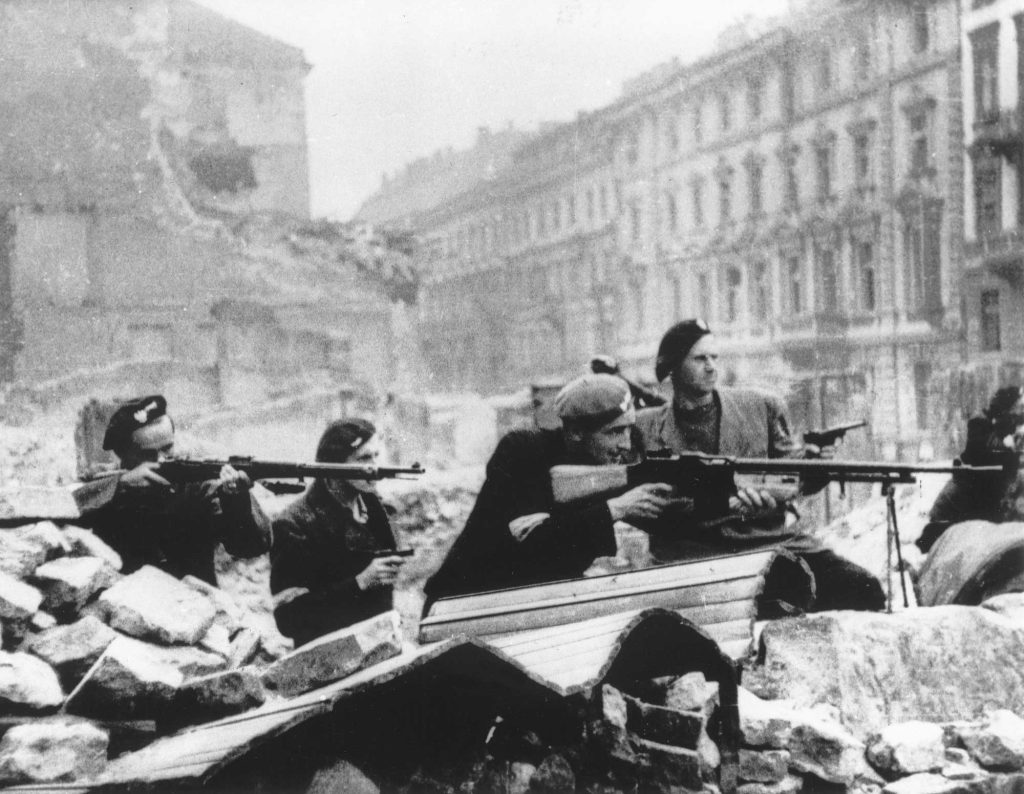
And poorly equipped the insurgents were. The Home Army, numbering between 20,000 and 50,000 soldiers, relied on an arsenal of no more than 1,000 rifles, 1,200 revolvers, 300 pistols, 7 heavy machine guns, 60 light machine guns, and 25,000 hand grenades.
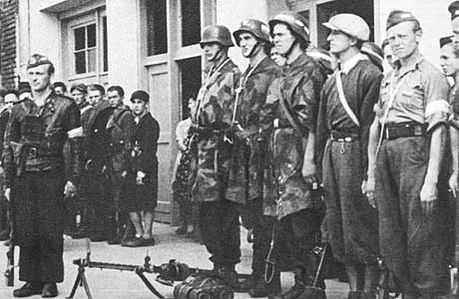
Despite this imbalance in opposing forces, by August 4 a large portion of the city was under AK control. Unfortunately, this proved to be something of a false dawn. German reinforcements, combined with Hitler’s order that Warsaw be “wiped from the face of the earth,” brought a new level of ferocity to the struggle. By August 8, an estimated 40,000 Poles had been massacred in the district of Wola alone.
As noted, despite these odds, and the growing lack of food and water, the Home Army held out for 63 days. But the conditions were grim. As one observer recounted:
“On every conceivable little piece of ground are graves of civilians and soldiers. Worst of all, however, is the smell of rotting bodies, which pervades over the whole centre [sic] of the city. Thousands of people are buried under the ruins. . . . Soldiers defending their battered barricades are an awful sight. Mostly they are dirty, hungry and ragged. There are very few who have not received some sort of wound. And on and on, through a city of ruins, suffering and dead.”
Finally, on October 2, 1944, the AK negotiated a surrender with German forces. Around 22,000 members of the AK had been killed. And even more staggering 150,000 to 200,000 Polish civilians had died by then as well.
But Warsaw’s agonies were not yet at an end. The remaining inhabitants of the city were expelled, and at least 90,000 were sent to forced labor camps and another 60,000 sent to concentration camps, including Sachsenhausen. As Odd Nansen wrote in his diary on August 15, 1944, when the evacuations were already underway:
“The 3,500 people on the road yesterday were refugees from Warsaw. Warsaw is burning. The Germans did it. Completely! One can imagine what is going on there! It’s strange that refugees whom the Germans have rescued the murdering Russians are to go into a concentration camp. From infants to aged people of both from sexes.”
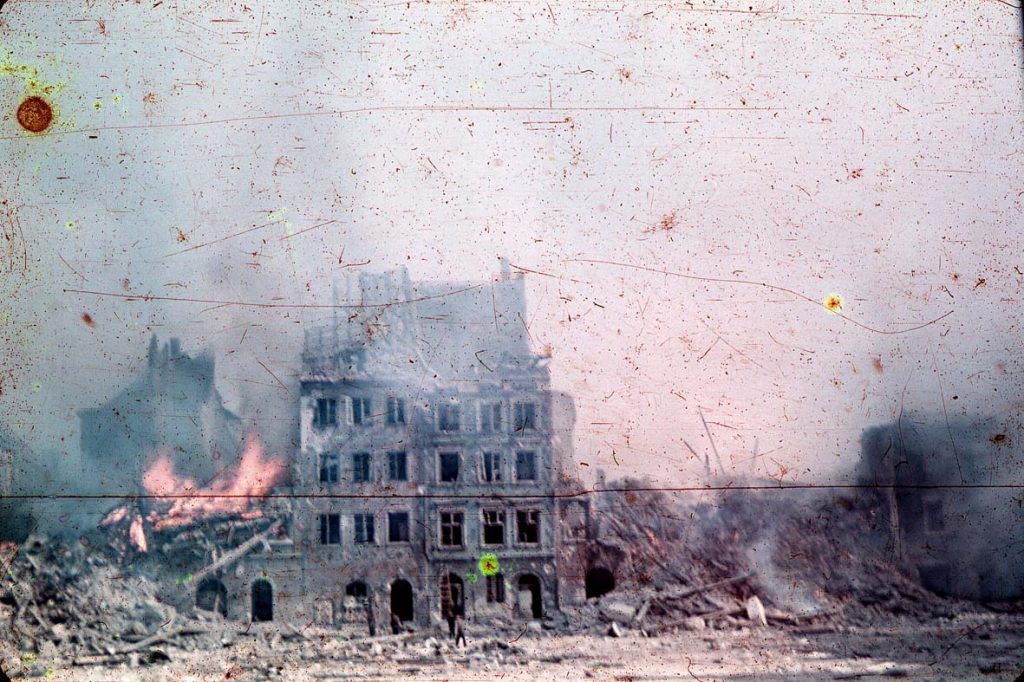
Once the city’s remaining population had been expelled, and pursuant to Hitler’s order, special German demolition teams were dispatched to destroy whatever structures still remained standing. By January 1945, when the Soviet army finally captured the city, 85% of Warsaw lay in ruins—whether from the September 1939 German Blitzkrieg campaign, the Warsaw Ghetto Uprising (which I have covered elsewhere), the uprising of August 1, or the systematic German actions afterward. Almost all the city’s historical monuments, its art, archives, places of interest, and the possessions of the city’s million-plus prewar inhabitants, were lost.
I’ll let Odd Nansen have the final word on this tragic event:
“The other evening I was talking to an old Pole in that Schonungsblock (convalescent hut). He was sixty-seven, but looked ninety-seven; bones, sinews, and skin apart, I’ll wager his flesh and stomach didn’t weigh five kilos [eleven pounds]. That he could hold himself up was a miracle, but obviously a miracle that would soon cease. He had great difficulty in speaking, and he spoke nothing but Polish. An interpreter translated. He was a Polish peasant from the Warsaw district, and had been “evacuated” here, starving and suffering, starving and suffering; of the rest of his family, children and wife, he knew nothing. They had lost each other during the “evacuation.” Now he had Durchfall (diarrhea) and couldn’t eat. he had already gone out, was no longer a man, only a poor, suffering, still living creature waiting for peace. There are hundreds and thousands like him–innocent, harmless, suffering human beings.”
—–Odd Nansen’s diary, Wednesday, December 13, 1944
Poland would remain part of the Soviet-aligned Eastern Bloc throughout the Cold War. However, memories of the Warsaw Uprising helped inspire the Solidarity movement, under labor leader (and later president) Lech Walesa, to end Communist rule in Poland in 1989.
August 1, the start of the Warsaw Uprising, is now commemorated as a state holiday in Poland. A moment of silence is observed at exactly 5:00PM.

