
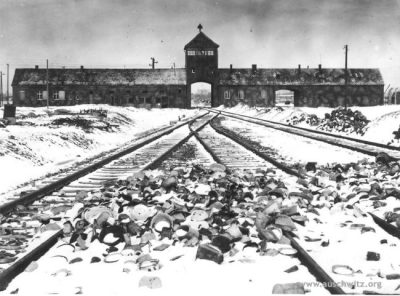
Seventy-seven years ago today Thomas Buergenthal, age 10, entered Auschwitz-Birkenau along with his parents. Originally the site of a Polish army barracks (inhabited briefly by Jan Karski), Auschwitz was developed by the Nazis into the largest and deadliest concentration/extermination camp ever. Approximately 1.1 million people—the population of Salt Lake City or Memphis—were murdered there. Of this number, almost 1 million were Jews.
In Buergenthal’s memoir, A Lucky Child, he writes that he was “lucky” to get into Auschwitz. This is not meant to be facetious. In many respects the worst day at Auschwitz was the first, for that typically meant a so-called selection at the railroad disembarkation ramp. Here, those who could not be expected to work under grueling camp conditions—children, the aged, invalids—were separated from the rest and sent directly to the gas chambers.
Often times, if the camp was approaching full capacity (an elastic concept), even the able-bodied were sent directly to be gassed. While I have done no study of the survival rate at the ramp, a few anecdotal examples provide some guidance. In Martin Gilbert’s book Kristallnacht, he writes: “[I]n February [1943] . . . a thousand [German Jews] . . . were deported to Auschwitz . . . from Breslau, of whom 994 were sent straight to the gas chambers.” Later he notes: “On 2 March 1943 one of the largest single deportations to Auschwitz took place: 1,500 Jewish men, women and children from Berlin. Of them, 1,350 were sent to the gas chambers on arrival.”
Thus, just getting into Auschwitz was something of a victory. “Had there been a selection, I would have been killed before ever making it into the camp,” Tom admits.
How did he escape the dreaded section? We’ll never know the exact reason, but Tom’s surmise is no doubt correct: “The SS officers . . . probably assumed, since our transport came from a labor camp, that children and others had already been eliminated in those camps.” Perhaps also the small size of Tom’s transport did not warrant a full-blown selection process.
Escaping a selection, however, while critical, was only half the story. Now Tom had to find a way to navigate the crucible of Auschwitz—“the last place on earth many of the prisoners sent there were destined to see.” Disease, starvation, exhaustion, and murder were just some of the dangers every prisoner faced every day.
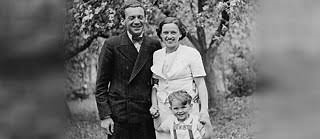
Tom was instantly separated from his mother at the ramp, and, but for one brief glance through the wire, he was not to see or be reunited with her for almost two and a half years. Tom’s father was also sent away in late October 1944, first to Sachsenhausen, and later to Buchenwald, where he would perish in January 1945. Now Tom was all alone.
How did he manage?
For several years leading up to August 1944, in the Kielce Ghetto and elsewhere, Tom was getting an education of sorts from his parents: “the essentials of survival.” In Auschwitz and later in Sachsenhausen, Tom continued to learn “the tricks I needed to survive.” Many other prisoners, by contrast, were thrust into Auschwitz directly from normal, middle-class environments without the benefit of such “training.” They could hardly be expected to adapt overnight to brutal camp conditions. One thinks of Anne Frank, whose final diary entry (August 1, 1944) was one day prior to Tom’s arrival. She went from living in the comparative safety of her annex on the date of her arrest (August 4, 1944) to the maelstrom of Auschwitz a few short weeks later (September 6, 1944). She, her sister Margot, and her mother Edith were all dead less than six months later.
Whatever the combination of factors—bureaucratic oversight by the Nazis, the innate or inculcated survival skills of a young child, or some other favorable alignment of the stars, on August 2, 1944, Thomas Buergenthal proved once again to be ein Glückskind—a lucky child.

