Dateline: January 6, 1941
President Franklin D. Roosevelt was about to give his State of the Union Address to Congress. It was his 9th State of the Union Address, the first since his unprecedented election to a third term.
The world was a mess.
German forces had subjugated Poland, Denmark, Norway, Netherlands, Luxembourg, and (once mighty) France. Italy was battling Greece; Britain was battling Italy in North Africa.
Britain was enduring The Blitz: Sheffield, Liverpool, Manchester, London, and Cardiff had all been bombed in the preceding five weeks. The island nation was also losing the Battle of the Atlantic—cargo ships were being sunk faster than they could be replaced, and more German U-boats were being commissioned every day—six in December alone.
The Warsaw Ghetto had been officially closed since November, cutting off 380,000 Jews from the outside world.
And worse was yet to come.
Unknown to all but his top generals, on December 18, 1940, Hitler had issued Directive No.21, setting in motion planning for Operation Barbarossa, the German invasion of the Soviet Union. At the time Roosevelt was to deliver his address in Washington it was already January 7 in Tokyo, where Japanese Admiral Isoroku Yamamoto presented to the Minister of the Navy his plan for war against the United States, a plan that called for a crippling first air strike against the U.S. naval fleet at Pearl Harbor (which would occur exactly 11 months later).
A year earlier (January 1940) the first secret gassing of those deemed “unworthy of life” had been carried out using bottled carbon monoxide at Germany’s Brandenburg Euthanasia Centre as part of Aktion T4. This use of technology (and this mindset) foreshadowed the Holocaust.
Roosevelt was still facing hard-core isolationists in Congress, even though a recent Gallup poll indicated that 68% of Americans believed the country’s future safety depended on Great Britain winning the war.
The President knew he needed something to rally Americans, and allies overseas, to resist, a reason to keep fighting. A set of goals that would inspire others when everything looked hopeless.
In the days leading up to January 6, the State of the Union Address had gone through several drafts, but something was still lacking. Roosevelt called together some of his closest advisors: Sam Rosenman, Harry Hopkins, and Robert Sherwood. As Rosenman would later relate, FDR announced that he had an idea for the peroration. “We waited as he leaned far back in his swivel chair with his gaze on the ceiling. It was a long pause—so long that it began to become uncomfortable.” Suddenly, “the words . . . seemed to roll off his tongue as though he had rehearsed them many times to himself.”
And this is what Roosevelt dictated:
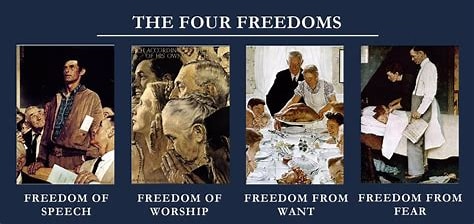
“We must look forward to a world based on four essential human freedoms. The first is freedom of speech and expression—everywhere in the world. The second is the freedom of every person to worship God in his own way—everywhere in the world. The third is freedom from want—which, translated into international terms, means economic understandings which will secure to every nation everywhere a healthy peacetime life for its inhabitants. The fourth is freedom from fear—which, translated into international terms, means a world-wide reduction of armaments to such a point and in such a thorough fashion that no nation anywhere will be in a position to commit an act of aggression against any neighbor.”
This State of the Union Address has since become known at the Four Freedoms speech. The sentiments were later transformed into iconic images by Norman Rockwell, depicted on the front cover of The Saturday Evening Post for four consecutive weeks in February and March, 1943. By the end of the war 4 million Four Freedoms posters had been printed, and they remain some of Rockwell’s best-known works.
Sadly, FDR did not live to see his four freedoms become a reality. They are still not realized in many parts of the world even today, 85 years later. And until they become a reality, many parts of the world will remain, as were many parts 85 years ago: a mess.