
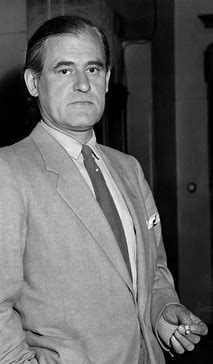
On this day 84 years ago, two important events occurred simultaneously:
- Odd Nansen, age 40, was taken hostage at the direction of Josef Terboven, Reichskommissar of Norway; and
- Representatives of nine German-occupied countries, meeting at the Third Inter-Allied Conference at St. James’s Palace in London, issued the Declaration on the Punishment of War Crimes
Now, Odd Nansen didn’t know he was a hostage on January 13, 1942. He had merely been informed he needed to travel to Oslo “for questioning.” He was most likely not overly alarmed. He had once earlier been taken in for questioning, and released. On the other hand, Nansen must have harbored some concern when three men (a district sheriff and two Germans) arrived at the cabin, owned by a friend, where he was enjoying a holiday with his family. After all, he was involved in the resistance.
In the end, his resistance activities (what he later described in his diary as his “wanton playing with fire”) remained unknown to his captors. Rather, he was detained as one of twenty hostages taken into custody in retaliation for a series of commando raids in Norway carried out by British and Norwegian soldiers several weeks earlier. So when, exactly, Nansen became aware of his hostage status remains unclear—his first use of the term “hostage” in his diary occurs on February 6, 1942, a few weeks after his arrest.
While prisoners of war are accorded certain rights and protections—at least as to those nations adhering to the Geneva and Hague Conventions—hostages have none.
Hostage taking is as old as warfare; that is, as old as mankind, and is the very embodiment of the notion of “might makes right.” A hostage’s continued existence is now subject to the whim of the hostage taker. It is the very explicit knowledge that the life of the hostage (who may well be innocent) can be forfeit at any time in retaliation for some future event that is intended to deter the future event. And to be at all credible, that threat must sometimes be carried out.
As SOE operative Benjamin Cowburn wrote in his memoir No Cloak, No Dagger: Allied Spycraft in Occupied Europe:
“One of the frequent manifestations of resistance was the killing of a German soldier. The population would learn of it by the appearance of bilingual notices on the walls and in the Metro stations giving the names of hostages who had been shot in reprisal, with a earning that worse would follow if such an act was repeated. Sometimes the list would be a long one with about twenty names.”
In other words, no due process.
The Inter-Allied Conference, consisting of eight allied governments-in-exile (Belgium, Czechoslovakia, Greece, Holland, Poland, Luxembourg, and Yugoslavia, as well as the Free French), together with Great Britain and the Commonwealth countries, first met on June 12, 1941, at St. James’s Palace to issue their initial joint statement on war aims and principles.
The Allied vision for a postwar world order was laid out in more detail in the Atlantic Charter jointly agreed upon in August 1941 by Great Britain and the United States, and subsequently endorsed at the Second Inter-Allied Conference in September 1941.
By early 1942 knowledge of German atrocities occurring in Poland, Russia, and other occupied countries was reaching the Allied governments, including “a regime of terror characterized amongst other things by imprisonments, mass expulsions, the execution of hostages and massacres.” (emphasis added). Accordingly, the parties at the Third Inter-Allied Conference agreed to “place among their principal war aims the punishment, through the channel of organized justice, of those guilty of, or responsible for, these crimes, whether they have ordered them, perpetrated them or participated in them.” Moreover, the parties resolved, “in the spirit of international solidarity,” to see that “(a) those guilty or responsible, whatever their nationality, are sought out, handed over to justice and judged, [and] (b) that the sentences pronounced are carried out.”
The Declaration was signed on behalf of the Free French by General Charles de Gaulle, and on behalf of the Norwegians, by Minister of Foreign Affairs Trygve Lie, who would later become the first Secretary-General of the United Nations.
The Declaration has been described as the “first milestone” towards the creation of an international framework for the prosecution of war crimes. It contributed to the establishment of an Inter-Allied Commission on the Punishment of War Crimes, later superseded by the United Nations War Crimes Commission, which in turn resulted in the Nuremburg war crimes trials.
Were all the goals of the Declaration issued 84 years ago accomplished? Not by a long shot (see my take on the Nuremburg Trials here). But a precedent had been set. Justice, however partial and imperfect, had been served. Criminality called to account. Might no longer made right. Just following orders no longer sufficed.
I think Odd Nansen, a victim of injustice 84 years ago today, would have approved.

