
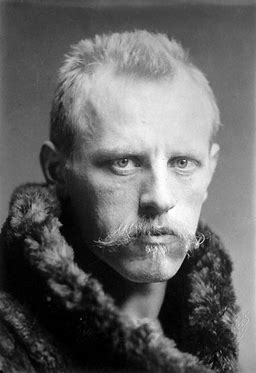
I’m a big believer in serendipity (which I have previously written about here, here and here).
After all, it was serendipity that brought Odd Nansen and Thomas Buergenthal together in Revier #3 in Sachsenhausen, where Tom was recovering from surgery and one of Nansen’s friends was also receiving treatment. Tom could just as easily have ended up in a camp other than Sachsenhausen in January 1945, as only a few thousand of the 60,000+ evacuees of Auschwitz were sent there. Moreover, Tom could have been sent to recuperate in Revier #1, #2 or #4 instead, in which case it is unlikely Tom’s and Odd’s paths would ever have crossed in a camp as large as Sachsenhausen.
And it was serendipity that caused me to read a footnote in Tom’s memoir, A Lucky Child, which ultimately led me to Odd Nansen’s diary, From Day to Day.
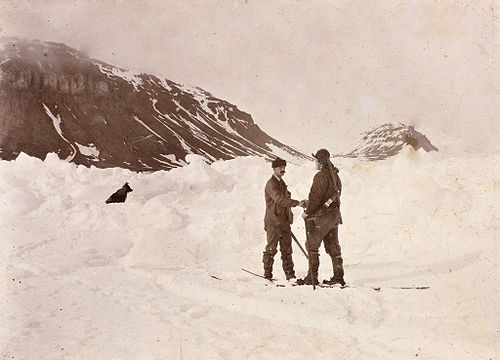
Those of you who have heard my lecture on the polar explorations of Fridtjof Nansen, Odd Nansen’s father, including his attempt to reach the North Pole, know that Nansen and his companion, Hjalmar Johansen, were serendipitously rescued when a hostile walrus opened a gash in Nansen’s kayak, forcing them to quickly beach their craft at the nearest island in the vast Franz Josef archipelago. That seemingly deserted island just so happened to be the base camp of a British exploration team headed by Frederick Jackson. In this way, Nansen and Johansen, who had by then been traversing the polar icecap, alone and essentially lost, for over a year, were at last rescued.
That fateful meeting between Nansen and Jackson took place 129 years ago today, on June 17, 1896.
Those of you who have heard my lecture also know that Fridtjof’s attempt at the North Pole was informed by an earlier, failed attempt known as the Jeannette Expedition (1879-1881). The Jeannette Expedition had been organized and financed by James Gordon Bennett, owner and publisher of the New York Herald, America’s then largest circulation newspaper. Bennett believed in creating news as much as reporting it—he had in fact previously financed Henry Morton Stanley’s 1871—1872 search in Africa for the missing Dr. David Livingstone. The resulting meeting between Stanley and Livingstone on the shores of Lake Tanganyika produced gallons of newsprint devoted to exclusive interviews, commentary, etc.—just as Bennett had hoped.
Not surprisingly, some writers have likened Nansen’s meeting with Jackson to Stanley’s chance encounter with Livingstone.
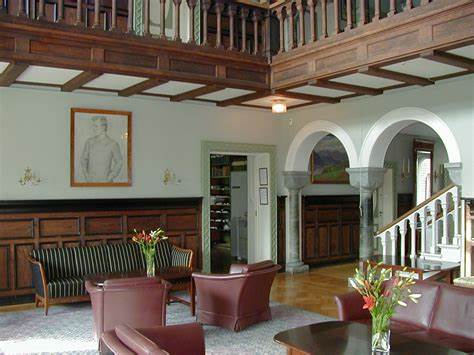
Recently, I had the good fortune of visiting Norway for a series of lectures. One of these lectures took place in Polhøgda, the Roman Revival mansion Fridtjof Nansen finished building in 1901. [I’ll admit I was a bit intimidated describing Nansen’s voyages, with the spirit of Nansen hovering so close by, to neighbors of Polhøgda whose ancestors had known the real Fridtjof Nansen, although in the end Nansen did not object and the neighbors were exceedingly hospitable.]
During my stay in Norway, I was a guest of Odd Nansen’s granddaughters, Anne and Kari, who were also unfailingly hospitable, and made my trip truly memorable. The bedroom I occupied had two large bookcases crammed with books owned by, or about, Fridtjof Nansen and his times. For a bibliophile like me, it was heavenly to handle books that Fridtjof Nansen himself had once owned and read, or were written about him.
One evening, before turning in, I was perusing some exceedingly worn volumes when I came across a book that had actually accompanied Nansen on his polar expedition. Knowing that he and his crew would have lots of time, potentially years in fact, on their hands as their ship, the Fram, slowly drifted with the Arctic icecap, Fridtjof Nansen had made sure that the ship’s library was well stocked. He brought along 600 books, by authors such as Ibsen, Zola, Dostoyevsky, and Goethe, to provide hours of distraction and edification for himself and his crew of 12.
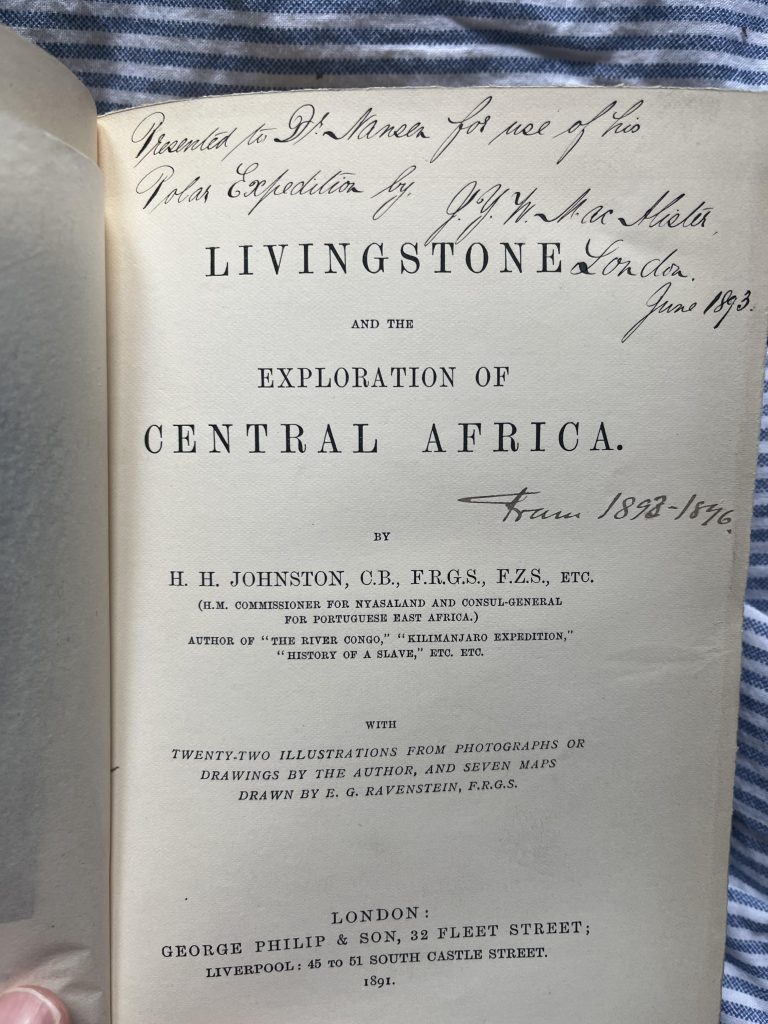
The book I held in my hands bore the following inscription on its title page: “Presented to Dr. Nansen for use of his Polar Expedition by J.Y.W. MacMister, London, June 1893.” Below that, in Nansen’s handwriting, was: “Fram 1893—1896.”
The name of the book?
Livingstone and the Exploration of Central Africa
Serendipity?!
PS: There are more such instances of serendipity from my recent Norway visit, which will be covered in future blogs. Stay tuned!

