
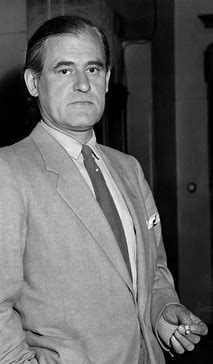
Odd Nansen died 52 years ago yesterday. He was 71. Every year on the anniversary of his death I write about some aspect of his life and personality.
As a prisoner, Nansen faced, and overcame, challenges that we, in our pampered, postwar lives, can scarcely imagine. But Nansen might not have been able to make it through his crucible without the help of one very important person: his wife Kari.
On July 20, 1942, a little over six months after his arrest and while still in Grini Prison, Nansen learned of a rumor that he would be consigned to an even worse circle of hell; that is, he was to be sent to Germany. [The rumor ultimately proved to be false, and Nansen was not sent to Germany until over a year later, in the Fall of 1943. That delay proved a blessing inasmuch as the prisoners in the earlier, 1942 transports, suffered greatly.]
Nansen was initially quite composed when he heard the rumor. But as he confessed to his diary that day, “when the thought of Kari and what might happen to her got hold of me in earnest, then it was worse.” Of course he had to tell of this important news. How would she take it? Nansen’s conclusion: “She will face it with her head high; she will defy and fight to the last gasp, for herself, for me, for the child [Kari was seven months pregnant at the time], and for the great cause of life itself.”
In my Introduction to From Day to Day I observe that “It was the bonds of love, more than anything else, that kept Nansen alive, hopeful, and human, during his long days of darkness.”
In her book, Memories of Our Fathers: Stories of Suffering, Resistance, Courage and Hope, Editor Gaby Hasenjürgen interviewed Norwegian war prisoners and/or their children to discuss issues of courage, resilience, perseverance, etc.
Hansenjürgen’s book contains an interview with Nansen’s son Eigil (of whom I’ve previously written, here), and provides a poignant reflection on how Kari coped with Nansen’s death in 1973, as well as his 40-month incarceration in Norway and later in Germany during the war.
“When my father died in 1973, after a serious illness, my mother, my youngest sister and I were present. My father struggled very hard and the moment he died we were all around him. Then the doctor said it was all over. But somehow Siri, my sister, and I felt that my mother ought to be alone with him for a while. So we left the room, and my mother was in there for, maybe, a quarter of an hour. Then she came out with a Mona Lisa-like smile, went down the corridor to the room where all the medical doctors and helpers waited, shook their hands and thanked them for the treatment of her husband—and then we all went home.
Ten or fifteen years later I could tell her ‘You impressed me by not crying, and you never shed a tear at any of those events directly after his death.’ Then she answered, ‘Eigil, I cried all my tears during the war. I never expected to get him back.”

