
Today, January 27, marks the 75th anniversary of the liberation of Auschwitz. The anniversary has been designated by the United Nations as International Holocaust Remembrance Day.
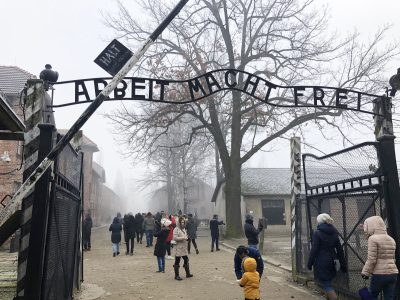
As the number of Holocaust survivors dwindles, as does the number of contemporary witnesses, and as antisemitism appears resurgent everywhere, even and especially here in the U.S., one is forced to ask: “How does one remember?” “What, specifically, does remembering the events of the Holocaust do?” “Why remember at all? Why not consign the event to the dustbin of history, and simply move on?”
I submit that we always need to remember, not so much to prevent others from committing atrocities, but rather to remind ourselves that no one is immune from the blandishments—and coercive power—of evil. Laurence Rees, writing in The Holocaust: A New History, about the Wannsee Conference which institutionalized the Holocaust, observes this about its participants: “[T]his meeting seems to represent what sophisticated, elegant and knowing human beings are capable of. Not many of them, perhaps, could kill a Jew personally—Eichmann claimed he had a ‘sensitive nature’ and was ‘revolted’ at the sight of blood—but they could enthusiastically endorse a policy to remove 11 million people from this world. If human beings can do this, what else can they do?”
If, as Rees writes, this is what sophisticated people are capable of doing, and if, as Primo Levi has warned, “It happened, therefore it can happen again, . . . it can happen everywhere,” what is our antidote, and the antidote for future generations?
In answer, I submit another quotation, from Lawrence Langer, writing in Admitting the Holocaust (emphasis mine):
“[E]very future generation will have to be educated anew in how to face the historical period we call the Holocaust. This must be done not through abstract formulas like ‘the murder of 6 million,’ but in graphic detail, so that the destruction of an entire people and its culture—what was done, how it was done, and by whom—makes an indelible and subversive impression on their moral, political, philosophical, and psychological assumptions about individual behavior, the nature of reality, and the process of history. The implications of the Holocaust are so bleak that we continue to wrestle with the desperate issue of how best to represent it. That problem still needs to be solved. Literature, history, testimony, commentary, theological speculation—many avenues exist for entering its vestibule, but no two approaches offer identical visions to those who cross the threshold into the landscape of the Holocaust itself.”
To me, Odd Nansen’s diary offers first-hand testimony, in graphic detail, of the Holocaust, but, more importantly, offers a standard of moral clarity as well, and thereby arms each of us to better resist evil whenever and wherever it inevitably arises. That’s my takeaway from International Holocaust Remembrance Day.

