
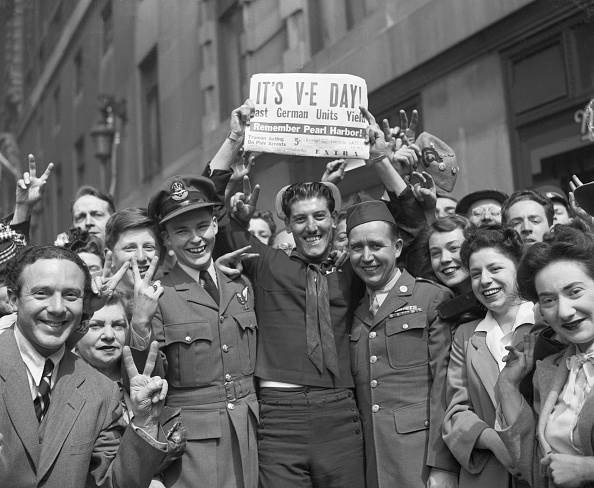
Today marks the 80th anniversary of VE Day, the official end of World War II in Europe. Eight days earlier (April 30, 1945) Adolf Hitler had killed himself in his underground bunker, where he had spent his final 104 days, unable to confront the ignominious end of his regime. Just four years prior (May 4, 1941), Hitler, in a speech given in Berlin, had remarked: “the National Socialist State stands out as a solid monument to common sense. It will survive for a thousand years.”
Anyone with an eye to anniversaries might also remember that almost exactly five years earlier (May 13, 1940), Winston Churchill, in his first speech as Prime Minister to the House of Commons, had stated: “I offer you nothing but blood, toil, tears and sweat.” Later in that same speech Churchill observed: “You ask, what is our aim? I can answer in one word: it is victory, victory at all costs, victory in spite of all terror, victory, however long and hard the road may be, for without victory there is no survival.”
Churchill proved to be a far better prognosticator than Hitler. After five years of blood, toil, tears and sweat, the Allies were victorious. But now Europe lay in ruins. Since September 1, 1939, millions of soldiers had died fighting for their respective countries. Millions of civilians had died from bombings and all the other disruptions brought by war. Millions of Jews had died in a holocaust of bullets and poison gas simply because they were Jews. And millions of other innocents, who do not fall into any of the above categories, perished as well, whether from disease, neglect, malnutrition, fratricide, or sheer despondency.
And even though the war in Europe was officially over, the killing and the dying continued:
- In newly-liberated camps like Bergen-Belsen, prisoners too weak to recover continued to succumb from their previous mistreatment well after May 8.
- Fighting between Soviet troops and die-heard German forces continued for a while yet in areas such as Slovenia and East Prussia.
- Fighting in Asia continued unabated. Three days after VE Day the USS Bunker Hill, an Essex-class aircraft carrier, was attacked by Japanese kamikazes, killing 396 U.S. sailors, or more than three times the number of patriots killed in the actual Battle of Bunker Hill.
- Even those who thought it was now safe found out it wasn’t always so. On May 9 an aircraft carrying 25 former British POWs home crashed on its way across the English Channel, killing all on board.
There are many schools of thought on historic causation. Some feel that economics drives the course of history; others, social conditions; others, disease or migrations. Others eschew such explanations and believe in some version of the “great man” theory for understanding historical developments—the idea that a single individual can affect the course of history.
Looking back on the devastation wrought in Europe from 1939 to 1945, it is difficult to not conclude that a world without Adolf Hitler—who had survived numerous assassination attempts—would have been safer, saner, and far less destructive.
That conclusion in turn raises yet another question: what was it about Hitler that allowed him to lead the German people—energetic, literate, cultured, scientifically preeminent—down such a path of destruction?
Historian Andrew Nagorski, in his book Hitlerland, offers one explanation:
“Even those Americans who initially dismissed the Nazi leader as a clownish figure came to recognize that he possessed an uncanny ability to mesmerize his followers and attract new ones. He knew how to tap into his countrymen’s worst instincts by playing on their fears, resentments and prejudices more masterly than anyone else. He possessed a combination of peculiar personal qualities and oratorical skills that fueled his movement’s rise. No other leading Nazi was as effective a mobilizing force as he was. Not Goering, not Goebbels, not his early rival Gregor Strasser. They, too, would have tried to exploit their countrymen’s anger and confusion following their defeat in World War I and the successive economic crises, but without the same results.”

