
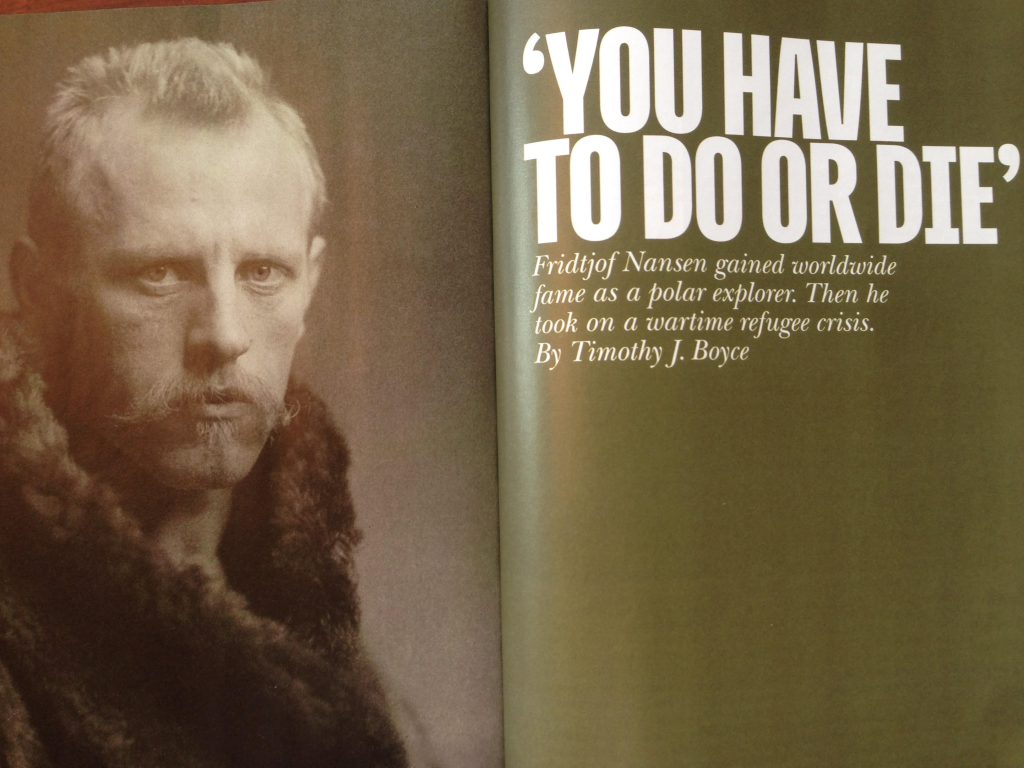
I am pleased to announce that the Winter 2019 issue of MHQ: The Quarterly Journal of Military History, has just hit the newsstands, and contains an article I authored regarding the Nansen Passport.
One of the many reasons Fridtjof Nansen was awarded the Nobel Peace Prize in 1922 was his work as the first High Commissioner for Refugees at the League of Nations. In this capacity, in 1922, Nansen promoted the use of an identity card for stateless Russian refugees, to allow them to safely cross national borders and seek work. All told, from its inception in 1922 through the start of World War II, approximately 450,000 individuals (Russians, and later, Armenians, Syrians and Kurds) were able to take advantage of the Nansen Passport. Prominent foreigners who came to America on the Nansen Passport include composer Igor Stravinsky, novelist Vladimir Nabokov, and pianist Sergey Rachmaninoff.
On my book tours I have had at least two occasions where audience members approached me after my presentation and related that they, or their parents, arrived in America as refugees using the Nansen Passport. The gratitude in their voices and expressions was palpable—it was clear to me that they viewed Fridtjof Nansen as their savior.
The complete article on the Nansen Passport can be found here. This is not the first time MHQ has shown an interest in the Nansen story. In its Spring 2018 issue the magazine reprinted selected excerpts from Odd Nansen’s diary, From Day to Day: One Man’s Diary of Survival in Nazi Concentration Camps. The online version of these excerpts can be found here. MHQ covers a variety of interesting topics, for the specialist and general reader alike–I highly recommend it to you.
The final word in this blog, as it is in my article, goes to Dorothy Thompson, the prominent American journalist who wrote in 1938, at the early stages of an even worse refugee crisis: “What the whole refugee problem needs today, more than anything else, is another Nansen, with his simple belief in human dignity, his enormous sense of personal honor and responsibility, and his confidence in the power of humanity to organize and mobilize to meet its emergencies.”

