
“Apart from the already described reactions, the newly arrived prisoner experienced the tortures of other most painful emotions, all of which he tried to deaden. First of all, there was his boundless longing for his home and his family.” —Victor Frankl, Man’s Search for Meaning
Odd Nansen would certainly agree with Frankl’s observation. In the second paragraph of his Foreword, Nansen explained that most of the “private matter” had been cut out of the published version of his diary, but not all: “I couldn’t cut it all out, I felt, without taking from the diary too much of its character. For it is the case that a prisoner thinks a great deal about his wife, his children, and home.” Indeed, as I write in my Introduction, in many ways From Day to Day can be viewed as one long love letter to Nansen’s wife Kari.
Longing suffuses the entire diary. “For more than a week, a fearful week, I had been looking forward to it [a meeting with Kari] and longing for it.” (May 7, 1942). “Longing keeps us in life and hope.” (January 30, 1944). In the very last diary entry Nansen wrote (April 27-28, 1945), he anguishes that “all I have been longing for for years with all my soul [seemed] more remote than ever.”
So, it was with great surprise that, during my recent visit to Oslo, Nansen’s granddaughter Anne Greve casually asked me if I knew the background to the bracelet she was wearing? It was a simple silver bracelet, adorned with a common-looking brown stone (there were originally three such stones, but only one remains):
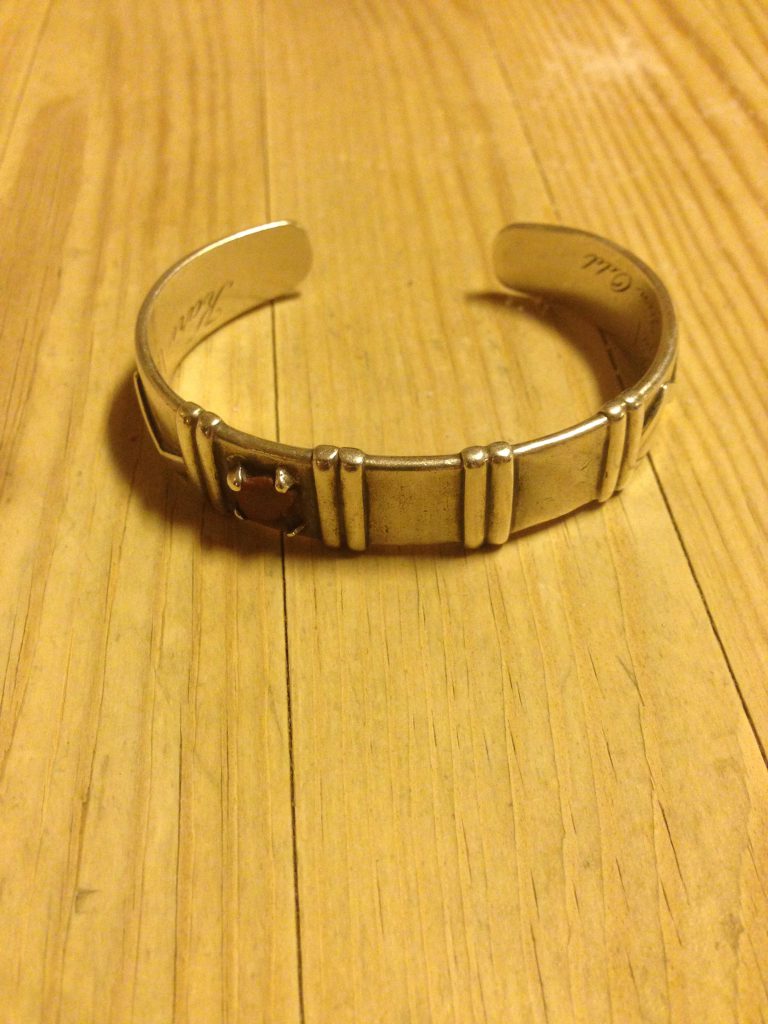
Inside the bracelet Nansen inscribed a simple, heartfelt message for his wife, on the occasion of their sixteenth wedding anniversary:
“Et Griniminne til dig fra mig/Vel ingen sjelden juvel/Men pant på at jeg elsker dig/Av hele min lengtende sjel/Din Odd/Grini 27-8-43”
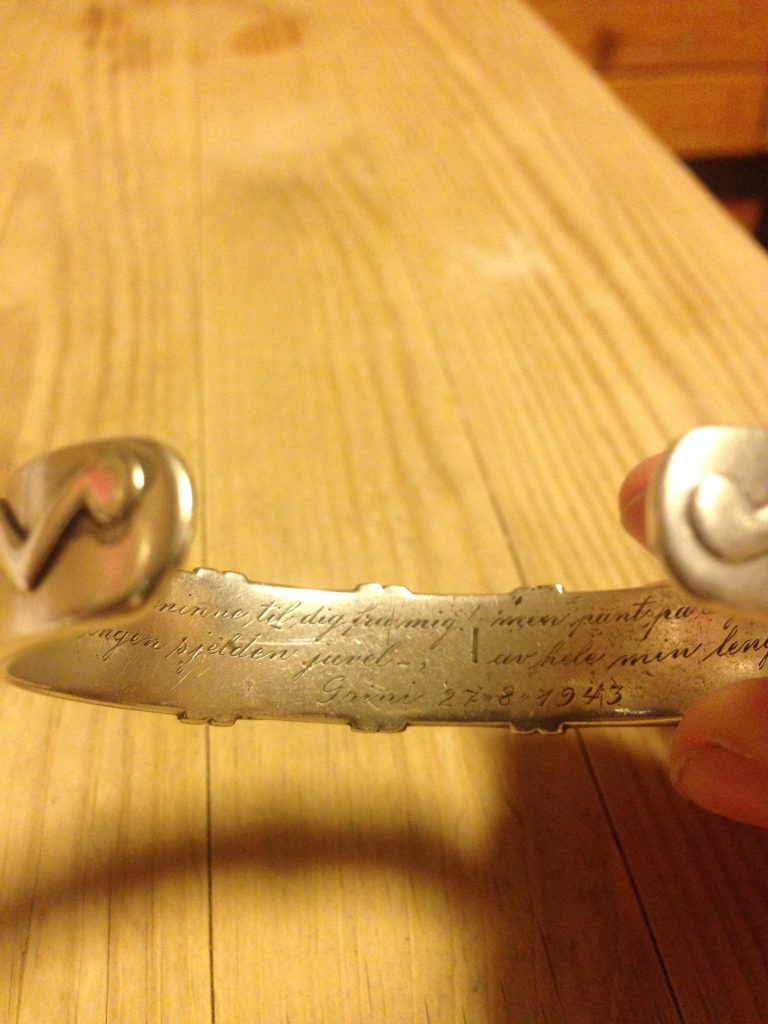
“A Grini memory to you from me/Well no rare jewel/But trust that I love you/With all my longing soul/Your Odd/Grini 27-8-43”
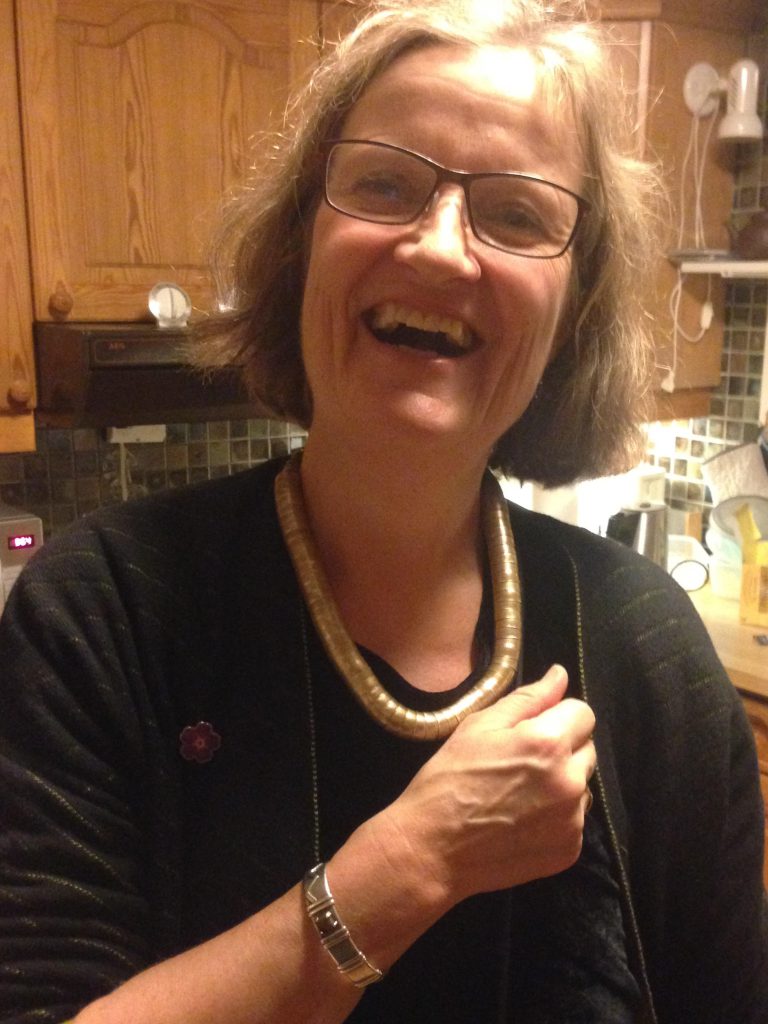
According to Anne, Nansen’s wife Kari wore it constantly throughout her life, and now Anne does as well:
Readers of the diary know that the portion which covers August 27, 1943 was unfortunately lost, so we’ll never know what thoughts or feelings, if any, Nansen recorded on that date. We do know what he wrote on the following anniversary, while in Sachsenhausen: “Sunday, August 27, 1944. Our wedding day! Seventeen years! . . . Life has been good to us after all. The wealth it has given us in these seventeen years no one can take from us. It is of eternity and will never die, even though we should never meet again.”

