
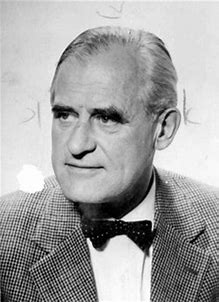
Today is the 117th anniversary of Odd Nansen’s birth on December 6, 1901.
Each year I try to commemorate his anniversary with a pithy statement or quote that encapsulates the kind of person Nansen was. In previous years I have quoted noted Holocaust survivor and writer Primo Levi (here), and Holocaust survivor and historian H.G. Adler (here).
This year’s quote comes from Eric Sevareid. Most members of my (baby boomer) generation know him from his days as a commentator on the CBS Evening News with Walter Cronkite. That’s how I came to know him, while still in elementary school, and I loved his trenchant, eloquent commentaries, even if the subject matter was sometimes well above my head.
What most people might not know is that Sevareid was from Norwegian stock. As Sevareid writes in his autobiography, Not So Wild a Dream, “Christmas dinner was never right for [my father] without lutefisk and lefse, and Pastor Reishus always preached first in Norwegian, then in English.” Sevareid was born in North Dakota, and lived for a while in my favorite ND city, Minot, before moving to Minneapolis. Taking up journalism in college, he soon found himself as one of “Morrow’s Boys,” reporting on the war for CBS. In 1940 he was the first to report on the Fall of France. As a broadcaster, Sevareid received numerous Peabody Awards and several Emmys, and was inducted in the Scandinavian-American Hall of Fame.
On August 2, 1943, Sevareid was investigating the Assam-Burma-China Ferry Command’s air supply of Chiang Kai-shek’s army over the Himalayas when his plane crashed. Miraculously, 21 of the 22 passengers and crew aboard the stricken plane managed to parachute safely into the jungle. The Americans were ultimately rescued by the British administrator in the region, Philip Adams. Here is how Sevareid describes Adams in his autobiography:
“For me, he takes a place among the few rare men I have known, of limitless courage, unfettered mind, and controlled compassion for others—the great, lonely men, some in the spotlight, others in obscurity, who are everywhere and always the same, devoted coworkers in the difficult and dangerous conspiracy of goodwill.”
I’m pretty sure that if Eric Sevareid had ever had the chance to meet Odd Nansen, he would have included Nansen in that select fraternity as well.

