
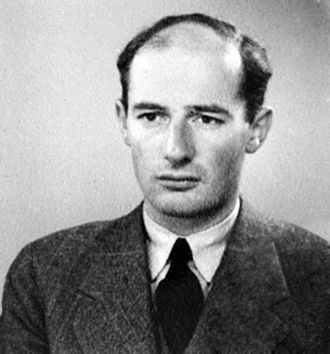
Eighty years ago today Raoul Wallenberg, a 31 year-old architect, businessman, diplomat and humanitarian, arrived in Budapest, Hungary. He had been recruited and appointed to the Swedish legation in Budapest to lead a rescue operation for Hungary’s beleaguered Jews who were then being deported to extermination camps in Germany. [Hungary, a one-time ally of Germany, began pursuing secret peace negotiations with the Allies following the catastrophic German defeat at Stalingrad. Learning of Hungarian duplicity, Hitler ordered a military occupation of the country, which occurred on March 19, 1944. Once Germany was in full control mass deportations began in May 1944.]
At tremendous personal risk, Wallenberg actively confronted his nemesis, Adolf Eichmann, and the Hungarian Arrow Cross Party, and with courage, energy, imagination, and intelligence, saved the lives of thousands of Hungary’s persecuted Jews. He issued protective passes, and sheltered Jews in rented buildings which he then declared to be “extraterritorial” and thus protected by diplomatic immunity. His work was so dangerous that he was forced to sleep in a different house each night. Those saved by his efforts, and their descendants, estimated at perhaps one million today, are a living testament to his miraculous work.
In addition to their both being Scandinavians, there are a remarkable number of parallels between Wallenberg and Odd Nansen:
- Both men were very artistic, and loved to draw when they were young.
- Both men were very talented architects, and both won architectural prizes at an early age (Nansen winning a third prize in 1929 and Wallenberg earning a second prize in 1935).
- Raoul Wallenberg once confided to his half-sister, Nina Lagergren, that his two childhood idols had been Elsa Brändström, a noted Swedish nurse, and the Norwegian explorer and humanitarian, Fridtjof Nansen, Odd Nansen’s father.
- Both Nansen and Wallenberg had their first significant, and transformative, exposure to Jewish suffering in the same year—1936. Wallenberg began working for a branch of the Holland Bank in Haifa, Palestine, and while there met Jewish refugees fleeing from a Germany that was enacting ever more severe anti-Semitic measures. According to his biographer Jeno Levai, “The[ir] stories of suffering had a great influence on him.” In that same year Nansen put his own career on hold and formed Nansenhjelpen, or Nansen Relief, to help stateless Jews stranded in central Europe obtain visas for Norway.
- In addition to their artistic skills, both men possessed valuable practical skills. Myrtle Wright, an English Quaker living in Norway during the war observed that Nansen “had an attractive personality and both as an organiser [sic] and propagandist [for Nansenhjelpen] was well suited for the work he had taken up.” Biographer Kati Marton relates that Wallenberg “was a man of passionate conviction and at the same time a very practical organizer.”
- Both Wallenberg and Nansen would spend time in captivity: Nansen as a prisoner of the Nazis and Wallenberg of the Soviets—although neither was ever charged, tried, convicted, or sentenced for any crime.
- Finally, and perhaps most importantly, both men believed in the power of a single individual, even when faced with the most extreme circumstances, to change the world for the better.
Wallenberg was last seen on January 17, 1945, during the Soviet siege of Budapest, when he was summoned to the headquarters of Russian General Rodion Malinovsky. To this day his exact fate remains unknown; all that is known is that he died in Russian captivity. His mother and stepfather both died by suicide in 1979, apparently in despair over the lack of definitive information about their son’s fate.
In 1981, Wallenberg was made an honorary citizen of the United States, only the second person to be so honored (the first being Winston Churchill). The bill conferring this honor had been sponsored by Congressman Tom Lantos (D. CA), whose life as a 16 year-old, and whose wife Annette’s life, were both saved by Wallenberg. In 1986, Wallenberg was made an honorary citizen of Israel, and recognized by Yad Vashem as one of the Righteous Among Nations. He was awarded the Congressional Gold Medal in 2012 in recognition of “his achievements and heroic actions during the Holocaust.”
In 2018 I was honored to give the keynote address at the 23rd Annual Raoul Wallenberg Memorial Dinner, sponsored by the Nordic Museum of Seattle, WA. Eight days later, I gave a presentation at an adult community in Walnut Creek, CA. After my talk, a woman approached me, introduced herself in heavily accented English, and stated: “I am a Hungarian Jew. I am alive today because of Raoul Wallenberg.”
(Portions of the foregoing appeared in an earlier July 11, 2018, blog.)

