
In the early morning hours of Monday, July 30, 1945—just minutes past midnight to be exact—the United States Navy suffered one of its worst disasters ever.
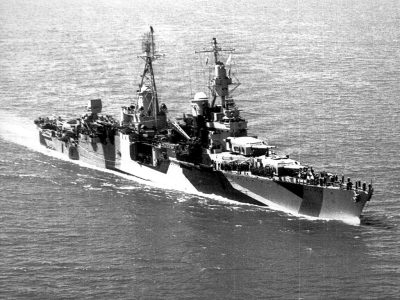
Two torpedoes fired from Japanese submarine I-58 slammed into the USS Indianapolis, a Portland class heavy cruiser captained by 46-year-old Charles B. McVay, III, with devastating effect. Despite its immense size (610 ft. long and displacing almost 10,000 tons) the Indianapolis took a mere 12 minutes to disappear into the deep Philippine Sea.
Only four days earlier, the Indianapolis, newly repaired and refurbished following a kamikaze attack on it during the Battle of Okinawa, had delivered a top-secret cargo to the island of Tinian in the South Pacific: the components of Little Boy, the atomic bomb that would be dropped on Hiroshima on August 6, 1945. After a brief stop in neighboring Guam, the Indianapolis was ordered to steam 1,150 miles to Leyte Gulf, the Philippines, for needed training before joining Task Force 95 off the coast of Japan.
The torpedo attack, and subsequent sinking, killed approximately 300 of the ship’s 1,195 crewmembers. The remaining 895 had only minutes to abandon ship—many without life rafts, life vests, provisions, or almost anything else needed to survive in the open sea. A distress signal had been sent prior to sinking; now all the survivors could do was wait, and, despite being 600 miles from Guam and 550 miles from Leyte, hope for a quick rescue.
And so they waited.
The sailors and Marines had to contend with a huge oil slick, blazing sun by day, hypothermia by night, horrendous thirst, salt water poisoning, and—worst of all—sharks. As one survivor recalled in 2014:
“Then the sharks came. I looked down and they were just swarming around us. Their tails would hit me every once in a while. There wasn’t really anywhere to go; we had to deal with them. The sharks seemed to go after the people that had big cuts to them, were naked or just in their skivvies. We lost a lot of good men in those first few days.”
And still they waited.
Through a combination of bureaucratic ineptitude and plain old human negligence, the ship’s SOS signal was ignored, and no one bothered to question why the Indianapolis failed to show up at Leyte at its appointed arrival time.
And still they waited.
For four nights and three days—more than 82 hours—the crewmen of the Indianapolis fended for themselves as they grew weaker, sicker, and more delirious.
Finally, around 11:00am on Thursday, August 2, a Navy pilot on a routine reconnaissance patrol spotted a huge oil slick and heads bobbing in the water, and immediately radioed for help.
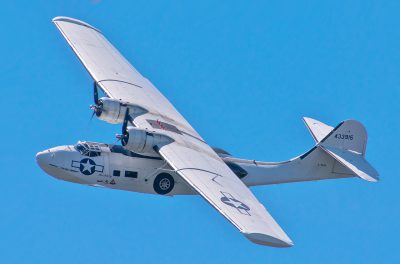
Nearly five hours later, the first rescue plane to arrive on the scene was a PBY-5A Catalina, named Playmate 2, piloted by Lieutenant Adrian Marks. The PBY was an amphibious seaplane, designed to land on water—calm, smooth, water. Navy regulations explicitly prohibited landings in choppy seas, lest the attempt damage the fragile fuselage.

Lt. Marks dropped off what little first aid he had—three life rafts (one of which promptly broke up upon impact with the sea), an emergency ration kit and a shipwreck kit (both of which the survivors were too weak to use).
When Marks saw that his efforts had so far failed to help the great mass of suffering survivors, and that many in the water would not last until a ship could arrive, he contemplated an emergency water landing. The problem: the sea was anything but smooth—swells were running at 12 feet. Landing under such conditions would risk the plane and the lives of his PBY crew, further compounding the unfolding disaster. Worse yet, Marks had never before tried an open ocean landing; according to Doug Stanton’s book, In Harm’s Way: “all previous attempts by members of his squadron had ended in disaster.”
Nevertheless, without hesitation, without seeking official permission, and after polling his crewmates, Marks attempted an emergency landing. The plane bounced into the air several times upon hitting the chop, but stayed afloat. He and his crew then began to rescue the most vulnerable survivors. Years later he recalled, “We would have to make heartbreaking decisions. I decided the men in groups had the best chance of survival. They could look after one another, could splash and scare away the sharks and could lend one another moral support and encouragement.” So Marks focused on the stragglers who were alone. Once the cramped fuselage had taken on as many sailors as physically possible, Marks and his crew began lashing men to the plane’s 104 ft. wingspan to prevent them from rolling off. No longer operable, the plane had been converted into an oversized life raft.
In this way Marks was able to save 56 men, all in terrible shape. He remembered:
“We had long since dispensed the last drop of water, and scores of badly injured men, stacked three deep in the fuselage and ranged far out on both wings, were softly crying with thirst and with pain.”
“And then, far out on the horizon, there was a light.”
It was the searchlight of the USS Cecil J. Doyle, a destroyer-escort, the first of seven rescue ships to arrive at the scene. Its captain, Graham Claytor, Jr., ordered searchlights to be turned on the water and straight up into the low clouds, illuminating the area despite the risk of possible Japanese submarines. By midnight the Doyle had arrived on the scene and was able to take on survivors, both those still in the water, and those on Marks’s plane (which was then sunk).
Unfortunately, by the time rescue efforts were completed, 112 hours after the Indianapolis had sunk—112 hours without food, water, or shelter from the sun, and under continuous attack by marauding sharks—only 320 of the approximately 895 sailors and Marines who had initially abandoned ship were still alive. Four more would die within the following week, reducing the total number of survivors to 316. Of the nearly 900 dead, upwards of 25% had just joined the Indianapolis—directly from boot camps, the Naval Academy, or midshipmen’s schools—in the days leading up to the ship’s departure from San Francisco on July 16, 1945, destination Tinian. Their entire experience of life at sea had lasted just 15 days.
For his intrepid actions, all in violation of Navy protocol, Adrian Marks was awarded the Air Medal, which is given for single acts of heroism or meritorious achievement while participating in aerial flight. It was presented to him personally by Admiral Chester Nimitz, Commander-in-Chief of the Pacific Fleet. [The Air Medal was also awarded during the Korean War to Navy pilots Jesse LeRoy Brown and Thomas J. Hudner, of whom I’ve previously written (here)].

Captain McVay was subsequently court-martialed for “hazarding his ship” by keeping a straight course rather than zigzagging. Although the U.S. Navy lost plenty of warships during World War II—more than 400—McVay was the only skipper to be court-martialed for the loss of his ship. In fact, he was the first captain in U.S. history to be court-martialed for losing a ship because of an act of war.
In 1999 McVay’s case was reopened. It was determined that intelligence (from ULTRA codebreaking) of a known enemy submarine in the vicinity of McVay’s proposed route was withheld from him. With no known threat, it was standard operating procedure to cease zigzagging at night when visibility was poor (as was the case on the night of the attack). In addition, McVay had requested—and been denied—an escort. Finally, the captain of the Japanese sub I-58 had previously testified at the court-martial that even if the Indianapolis had been zigzagging, his torpedoes, launched in a fan-shaped direction, would most likely have struck the ship.
Accordingly, in 2001 the Secretary of the Navy ordered that the following be appended to McVay’s service record:
“The American people should now recognize Captain McVay’s lack of culpability for the tragic loss of the USS Indianapolis and the lives of the men who died as a result. . . . Captain McVay’s military record should now reflect that he is exonerated for the loss of the USS Indianapolis and so many of her crew.”
Unfortunately for McVay, winner of the Silver Star, son of the former Commander-in-Chief of the U.S. Asiatic Fleet, this vindication came 33 years too late. McVay died by suicide on November 6, 1968, haunted by the letters he continued to receive over the years, especially near the holidays, from families of dead crewmembers, blaming him personally for the deaths of their sons, brothers, and fathers. He apparently had received one such hate letter on the day of his death.
Four days after Lt. Marks’s dramatic rescue, Little Boy was dropped on Hiroshima. A member of the bomb’s assembly crew had written on its side: “This one is for the Boys of the Indianapolis.” Eight days later Japan surrendered.
World War II was over. The Indianapolis would be the last major naval vessel to be lost during the war.
No one was ever held to account for the unconscionable delay in rescuing the survivors.
Adrian Marks lived a long and full life after the war, passing away in 1998, age 81. At the 1975 reunion of Indianapolis survivors, Marks addressed the gathering:
“I met you 30 years ago. I met you on a sparkling, sun-swept afternoon of horror. I have known you through a balmy tropic night of fear. I will never forget you.”
As of this writing only one survivor, Harold Bray, remains alive, the last living link to a tragic event—“one of the darkest pages in our naval history” according to The New York Times—a tragedy lessened in part by the heroic actions of Adrian Marks.

