
How does a B-24 Liberator bomber, weighing up to 32 tons and having a wingspan of 110 feet, together with a crew of nine, simply vanish . . . . and on its maiden flight no less?
Eighty-two years ago today, a B-24 christened Lady Be Good (named after a 1941 musical film starring Lionel Barrymore and featuring the Academy Award-winning song “Last Time I Saw Paris”) took off from Soluch Field in northeast Libya on its first mission.

The plane and its crew, which weeks earlier had just joined the 514th Squadron, 376th Bomb Group, 9th Air Force, were headed north for a high-altitude bombing run against harbor facilities in Naples, Italy, 700 miles away. Twenty-five B-24s were earmarked for the mission. After an uneventful early afternoon takeoff, the mission soon seemed jinxed when many aircraft aborted in the face of violent sandstorms. The Lady Be Good nevertheless continued on. Reaching Naples by 7:50 PM only to find the harbor hidden under a cloud cover, the bombers headed for secondary targets. When these were unavailable, they dropped their bombs in the sea to lighten their loads.
Returning, alone, in the dark, the Lady Be Good lost its bearings, and radioed to Soluch at 12:12 AM that its automatic direction finder was not working, requesting assistance. Either the crew did not receive the requested inbound bearing, or else misinterpreted it. In any event, flying in utter darkness, the crew of the Lady Be Good thought they were still over the Mediterranean, when, in reality, they had already overshot Soluch Field and were flying deeper into the Libyan interior.
By 2:10 AM, with fuel running low, and still mistakenly believing they were over open water, the crew elected to bail out, wearing their Mae West life preservers. Eight crewmen parachuted to safety. The ninth, Bombardier Lt. John Woravka, either died upon impact, or shortly thereafter, apparently due to a faulty parachute.
The remaining eight gathered to discuss strategy and a plan.
The key question: Where were they?
The crew had landed in the Calanshio Sand Sea, part of the vast (500,000 sq. mi.) Libyan Desert. The Libyan Desert is said to be “one of the least hospitable regions on earth.” Daytime temperatures can average 122°F. in the summer, and even hit 81°F. in the dead of winter; at night, on the other hand, temperatures can plunge rapidly.
All the eight survivors possessed were their uniforms, their parachutes, some snacks, and one half-empty canteen. Unbeknownst to the crew, their plane continued to fly south, untended, for another 16 miles, gradually losing altitude, before landing in flat terrain, relatively unscathed. Preserved within the ship were food and water as well as a working radio.
Feeling northwesterly breezes, and thinking they were much closer to the Mediterranean than they actually were (over 400 miles away) the band set off at daylight, heading northwest.
Meanwhile, at Soluch Field, officials sent out the appropriate search parties, primarily over water, with negative results. Within days the plane and its crew were officially listed as “missing, presumed dead.”
Two members of the stranded crew, co-pilot Lt. Robert Toner and Flight Engineer Sgt. Harold Ripslinger, had the presence of mind to record their daily march north. At first the entries were simply matters of fact. Toner: “Started walking N.W., still no John [Woravka]. A few rations, ½ canteen of water. 1 capful per day. Sun fairly warm, good breeze from N.W. nite very cold. no sleep. rested and walked.” Ripslinger: “Waited a while [for Woravka] and started walking. Had ½ sandwhich (sic) & piece of candy & cap of water in last 36 hr.” Quickly, however, the combination of little food or water, intense heat, fatigue, and blinding sun, led to rapid deterioration. By day six both journals contain the exact same ominous phrase: “all want to die.”
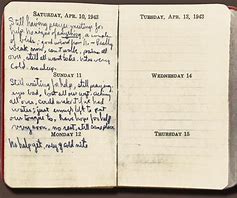
By that point—approximately 78 miles from their start (distances vary depending on which account you read) five of the party of eight (Toner, pilot Lt. William Hatton, Navigator Lt. Dp (sic) Hays, radio operator Sgt. Robert LaMotte and gunner Sgt. Samuel Adams) could no longer continue, and the three who were relatively healthier (Ripslinger, flight engineer Sgt. Guy Shelley, and asst. radio operator Sgt. Vernon Moore), agreed to continue on in their search for help.
Ripslinger’s last journal entry ends on day eight. Some or all the three had covered another 30 or so miles. The crew had done the near impossible. They had lasted longer and travelled farther (100+ miles) than anyone thought conceivable in such a harsh environment. Unfortunately, they were still hundreds of miles from their goal.
Years passed. The war ended. The Cold War ramped up. Reunions were held. People remarried. Children grew up. But still the mystery of Lady Be Good’s whereabouts continued.
For another 16 years.
In May 1958, a British oil exploration team, flying over the Libyan Desert, spotted the wreckage of the Lady Be Good, and marked the location on maps to be used by oil-prospecting teams which were due to explore the Calanshio Sand Sea the following year. Authorities at Wheelus Air Base, located in northwestern Libya and at the time the largest U.S. military facility outside the United States, were alerted to this discovery, but as there was no record of any plane thought to be lost in the area, they were unresponsive.
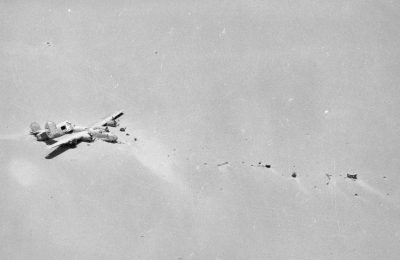
Ten months later, in March 1959, a ground team was dispatched to the marked site by D’Arcy Oil Company (later merged with British Petroleum). Their report, conclusively identifying the plane and its former crew, all miraculously preserved in the dry desert, finally spurred officials at Wheelus and the Army Quartermaster Mortuary to investigate, which they did from May 1959 to August 1959.
Although much equipment was recovered from the crash site, the search for airmen’s remains proved fruitless, and further efforts were discontinued as “the probability of the airmen being completely covered by shifting sands made the danger of further search impractical.”

Where were the missing airmen?
Six months after the U.S. officials had halted their search efforts, in February 1960, the employees of British Petroleum did it again—they discovered the remains of the five airmen who had collapsed on day six. Lt. Toner’s journal was discovered at the time as well.
This new discovery once again spurred the U.S. Government to try and locate the remaining four missing airmen: Woravka, Ripslinger, Shelley and Moore. Dubbed “Operation Climax,” the joint effort of the U.S. Army and Air Force succeeded in locating the remains of Sgt. Shelley miles beyond the location of the first five members, and those of Sgt. Ripslinger (together with his journal) even further north of Shelley’s remains.
Operation Climax ended in May 1960, with two men (Woravka and Moore) still unaccounted for.
For a third time, it was employees at British Petroleum who came to the rescue. Three months after Operation Climax ended, they discovered the remains of Lt. Woravka, who had died while bailing out on the night of April 4.
The remains of Sgt. Vernon Moore, who had set off with Shelley and Ripslinger, have never been located.
The What Ifs
As in all such tragedies, it is easy to second-guess the decisions made by this novice crew on their first combat mission on April 4:
- What if, like many of the other bombers detailed to attack Naples, the crew of the Lady Be Good had aborted and returned to base?
- What if the automatic direction finder hadn’t failed on the plane’s very first mission?
- What if the survivors had chosen instead to look for their relatively intact plane (only 16 miles away) with food, water, and a radio that still worked when it was tested 16 years after the crash?
- What if the crew had simply headed south instead of north? Had they covered the same distance in that direction as they had achieved walking north, they might have reached the oasis at Wadi Zighen.
The Afterlife
The afterlife of the Lady Be Good story is almost as unusual as its brief and tragic existence.
For example, since the Lady Be Good was in such relatively good shape despite, or rather because of, its desert home, parts of the plane were salvaged and, after being tested, were reused in other U.S. planes. Many of these same planes subsequently experienced mechanical issues which lead to their crashing. In one instance a U.S. Army de Haviland Canada DHC-3 Otter received an armrest from the Lady Be Good. That plane later crashed into the Gulf of Sidra (incidentally adjacent to Libya). Only a few traces of the plane washed ashore, although one of them happened to be the Lady Be Good armrest.
Finally, on September 30, 1960, only one month after the remains of the eighth airman, John Woravka, were located, The Twilight Zone opened its second season with a premiere episode entitled “King Nine Will Not Return.” In this episode, it is WWII again, and a B-25, nicknamed King Nine, has taken off from an airbase in Tunisia to bomb the southern tip of Italy. On its return flight it is struck by flak and is forced to make an emergency landing in the North African desert. After that, things get really weird, as only they can on The Twilight Zone—you can see the episode on any number of platforms if you search. [One scene depicts a grave marker for one of the crewmembers of King Nine. It is dated 5 April 1943—the very day the Lady Be Good disappeared.]


