
Sometimes courage can be found in the most unexpected circumstances.
The date: August 1944
The place: Fresnes Prison, located on the outskirts of Paris
The cast: 168 captured Allied airmen (82 American; 48 British; 26 Canadian; 9 Australian; 2 New Zealand; I Jamaican)
By August 1944 the Fresnes Prison held, along with members of the French Resistance, 168 Allied airman who had previously been shot down over France, Belgium, and the Netherlands. For reasons which remain unclear (although likely due to the fact that the airmen were all captured while trying to escape to safety, and thus were no longer in uniform and, in some cases, without even dog tags) the prisoners were under the jurisdiction of the German SS, and not the Luftwaffe, to be treated as spies and criminals rather than as POWs.
With Allied forces on the verge of capturing Paris, the SS decided to evacuate these Allied airmen to a concentration camp in Germany: Buchenwald. Accordingly, on August 15, 1944, all 168 prisoners joined a larger crowd of over 2,100 other prisoners who were all herded onto cattle cars on the last train to leave Paris’s Pantin Station before its liberation. [I’ve written about the last train to leave another Paris station, Drancy, before liberation, and its tragic inhabitants here.]
After a grueling five-day journey, the Allied airmen reached Buchenwald, a forced-labor camp located near Weimar in east-central Germany. There they were sequestered in a subcamp known as “Little Camp.” Without shoes, and forced to sleep out on the open, rocky, ground, and with their identity documents stamped “DIKAL” (Darf in kein anderes Lager/Must not go to any other camp), it seemed only a matter of time before the airmen would all succumb. (Of the approximately 250,000 prisoners who spent some time in Buchenwald or its subcamps, at least 56,000 died. One of the dead included Tom Buergenthal’s father, Mundek, who died on January 15, 1945, just weeks prior to liberation.)
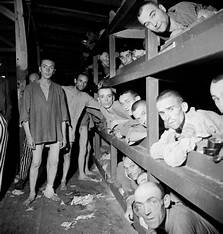
It was clear to the Allied airmen that any chance, however slim, must be taken to alert the outer world of their plight.
A prisoner in the main camp who was detailed to work at a nearby German Air Base somehow smuggled out word that captured airmen were being held at Buchenwald. Eventually this information reached the ears of one Otto Hans “Hannes” Trautloft.
At the time Trautloft was nothing short of a superstar in the Luftwaffe. With 58 confirmed kills (5 in Spain; 8 on the Western Front and 45 on the Eastern Front) Trautloft had risen to the upper echelons of the Luftwaffe, responsible for all day-fighters in the German air force.
Now, Trautloft had no responsibility for, or jurisdiction over, Buchenwald’s prisoners, including its airmen, and would gladly have tried to shoot them down if he had met them in the sky, but he also recognized that the airmen were POWs who belonged in a POW camp, not in Buchenwald.
Nevertheless, he could have temporized, ignored the message, delegated the responsibility to someone else, or washed his hands entirely of the matter. There was a war going on after all, and he certainly had higher priorities.
In the end, Trautloft decided to visit the camp himself, using, as an excuse, a desire to inspect some nearby factories damaged by a recent Allied air raid.

Trautloft toured Buchenwald, trying to determine if any of its prisoners could in fact possibly be captured Allied airmen. By this time, however, the Buchenwald airmen were so brutalized that they were indistinguishable from all the other inmates of the camp.
Trautloft turned away from the fence, and was about to leave. As author Tom Clavin relates in his book Lightning Down:
“[W]ithout the deus ex machina that Trautloft represented [the airmen] would most likely die. This moment was their last and best chance. But it was clear that if any commotion was made, they would either be shot immediately or severely punished later after the Luftwaffe officers were hustled away.”
Then one Allied airman called out.

It was gunner Bernard Scharf, of the 8th Air Force, 91st Bomb Group, 323rd Squadron. Scharf, who was the son of a German immigrant and spoke fluent German, risked his life by quickly explaining the plight of the Buchenwald airmen. When the SS officers intervened, pressing Trautloft to leave, he reminded them that he, the decorated war hero, outranked them, and returned to the fence to learn the full story. He gave no indication what he would do with this information, and promised nothing. Nevertheless, he ultimately elected to take the matter up with the head of the Luftwaffe, Herman Göring. (Göring himself was by this time on the outs with Hitler because of the performance of his Luftwaffe, and it was by no means certain that he had enough clout vis-à-vis the SS to effect any transfer even if he was so inclined.)
Ultimately, Trautloft’s efforts paid off, and on October 19th or 20th (accounts differ) the Allied airmen left Buchenwald for a POW camp, Stalag Luft III, arriving on the 22nd. [Stalag Luft III was the scene, earlier that year, of the infamous Great Escape, which occurred 81 years ago today, and about which I have written here).
What the Allied airmen did not know, as they boarded a train to their new camp, was that the Commandant of Buchenwald, Hermann Pister, had scheduled the airmen for execution only days later, on October 25. Camp authorities had already carried out the execution of 16 members of the British Special Operations Executive—the SOE—on September 9, 1944.
All told, 166 airmen were successfully moved to Stalag Luft III; two prisoners died in Buchenwald of illnesses they contracted in the camp.
If Trautloft had not intervened, and if Scharf had not spoken up, it is unlikely that any of the Allied airmen would have survived till the end of the war.
Trautloft later participated in the “Fighter Pilots Revolt incident” in early 1945, and along with others, was relieved of his position and put in charge of a flight school instead. He joined the new German Air Force in 1957, and retired in 1970 as a Lieutenant General. Upon retirement he received the Great Cross of Merit from the Federal Republic of Germany. Trautloft died in 1995, age 82.
Hermann Pister, Commandant of Buchenwald, was convicted of war crimes and sentenced to death by hanging. He died of a heart attack on September 28, 1948 while awaiting execution.
Bernard Scharf died in 1982 in Boonville, CA, age 69.
The last surviving member of the “KLB Club” (Konzentrationslager Buchenwald), Stanley Booker, a member of the Royal Air Force, died this past January 26, 2025. He was 102.
A tip of the hat to my friend John Townsend, who put me on to this story.

