
“Yesterday [was] . . . one of the heaviest raids we have ever witnessed. It was on Oranienburg, and camps and buildings in the immediate neighborhood of Sachsenhausen were leveled to the ground.
From the moment the first bombs dropped, we realized that this was more our concern than usual. For in general we’ve gotten used to taking very little notice. But the bomb thuds this time were not to be stifled. At every deafening crash, and one had the impression that whole showers of bombs were coming down, the huts shook so that everything hanging on the walls or standing loose on shelves fell to the floor, and every moment we were expecting that the roof would lift in the blast and the walls collapse on us. But they stood up, for a wonder. The raid lasted two hours—that is, it didn’t stop, only quietened down a bit, and the planes stopped coming; otherwise it’s still on, twenty-four hours later, and has been all the time, with an unbroken series of exploding time bombs. During the raid the whole of Oranienburg and the district up to this camp were larded with bombs, a large proportion of them time bombs. All night long colossal explosions have been shaking the huts in all their joints.”
Odd Nansen’s Diary, Friday, March 16, 1945
Apart from the unusual intensity observed by Odd Nansen in his description of the bombing of Oranienburg, site of Sachsenhausen Camp, 80 years ago today, there is little to suggest any deeper significance behind the raid of March 15, 1945. The U.S. Army Eighth Air Force description of the raid was similarly unhelpful. Mission 828 involved the dispatch of 612 B-17 Flying Fortresses to hit “German Army HQ and marshalling yards at Oranienburg.”
One might question why 612 bombers needed to drop 1,500 tons of high explosives and another 170 tons of incendiaries to take out some marshalling yards and a headquarters site.
And, apparently, there is more to the story.
Unbeknownst to Odd Nansen, Oranienburg was the home of Auergesellschaft, an industrial firm. Founded in 1892 by German-Jewish entrepreneur and banker Leopold Koppel and Carl Auer von Welsbach, the company specialized in research and manufacturing in areas of rare earths, radioactivity, uranium, and thorium-based products such as gas mantles. One of their other product lines in the 1920s even included Doramad, a radioactive toothpaste with trace amounts of thorium. (Without a hint of irony it touted Doramad’s hardening of teeth and “brighter smile.”)
Aryanized in 1934 (i.e., stolen from Koppel), by 1939 Auergesellschaft had turned to high-grade uranium oxide processing—part of Germany’s nascent atomic research program.
So, it wasn’t marshalling yards that the Eighth Air Force were so eager to get at after all.
According to historian and Churchill biographer Martin Gilbert: “[O]n March 15, American bombers, at the urgent request of Major-General Leslie R. Groves, the head of the American atomic bomb ‘Manhattan’ Project, dropped nearly 1,300 [sic] tons of high explosives and incendiary bombs on the German thorium ore processing plant at Oranienburg. All the above-ground parts of the plant were completely destroyed.” Furthermore, “German atomic bomb research [was] brought to a halt.”
But even that description is a bit misleading.
By mid-March 1945, Germany’s war effort was in shambles—the nation would capitulate less than eight weeks later. As early as late 1944 it had become evident to the Alsos Misson that Germany’s atomic effort had not gotten past the research and development stage. The Alsos Mission was a joint U.S.—British undertaking to 1) investigate the extent of Germany’s atomic bomb efforts and 2) seize any German nuclear resources that could be useful to the Manhattan Project. The unstated corollary to this last point was the desire to deny any such resources to the Soviets. Not surprisingly, the Soviets had a similar effort underway in the areas they occupied.
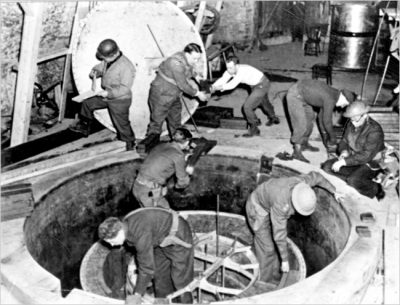
By the time Nansen witnessed the March 15 raid, it had been agreed that Oranienburg would end up in the Soviet occupation zone. (Oranienburg, and Sachsenhausen, including Tommy Buergenthal, were liberated by Soviet forces five weeks later, on April 22.) But interrogations of German POWs revealed that uranium and thorium processing was occurring at Auergesellschaft. If the Alsos Mission was not going to capture Auergesellschaft intact, with its nuclear secrets, the U.S. and Great Britain were equally determined that the Soviets were not going to either. So, the attack of March 15 was directed, not at the Germans, but at the Soviets.
Odd Nansen had witnessed, and unwittingly written about, not the final act of World War II, but the opening act of the Cold War.
Note: Because of the unprecedented bombing effort aimed at it, and the large amounts of radioactive elements released into the surrounding area from the bombing, Oranienburg to this day is called Germany’s most radioactive city. Moreover, due to the amount of unexploded ordnance resulting from the March 15 raid, which is still being carefully removed to this day, it is also called Germany’s most dangerous city.
Note: Despite the efforts of the Eighth Air Force, the Soviets were able to capture several tons of high-grade uranium oxide elsewhere in Germany. According to Soviet nuclear physicist Yulii Khariton, this captured uranium advanced the Soviet atom bomb project by at least one year. The Soviets exploded their first nuclear device on August 29, 1949.

