
[Note: The following was to have been published yesterday, but I was without Internet all day.]
“Ich habe Deutschland auch so geliebt/And I have loved Germany so much.” Mildred Fish-Harnack
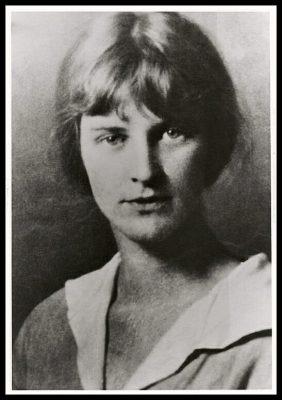
Mildred Fish was born September 16, 1902 (or about nine months after Odd Nansen) in Milwaukee, WI. Growing up in a heavily ethnic German neighborhood in Milwaukee, she learned to read, write, and speak English and German at an early age. Mildred received a Bachelor’s Degree in English Literature from the University of Wisconsin in 1925, and a Master’s degree in 1926. At the University she met and fell in love with a German exchange student, Arvid Harnack. They were married in 1926. Two years later Arvid returned to Germany, and Mildred followed him in 1929.
In Germany Mildred began working on her doctorate in American Literature, studying at various universities in Jena, Giessen, and Berlin; she would finally earn her PhD in 1941 from the University of Giessen. While pursuing her degree she also taught at the university and gymnasium levels, and she and her husband hosted a literary salon.
Mildred and Arvid watched with growing alarm the rise of Nazism in Germany, and soon became involved in a loose network of underground resistance groups, later referred to as the “Red Orchestra.” In addition, according to author Andrew Nagorski (Hitlerland), during trips around Europe as a literary scout for a German publisher, Fish-Harnack “may have helped Jews and others to escape from Germany, although the evidence is patchy.”
With the arrival of William Dodd as American Ambassador to Germany (August 30, 1933) Mildred became close friends with Dodd’s daughter Martha, based on their shared interest in literature (they co-wrote a newspaper column on books). Mildred also socialized with Donald Heath, First Secretary and monetary attaché at the U.S. Embassy, and his wife. The Heaths even hired Mildred to tutor their son in literature.
Soon Heath was sending reports to Washington about Germany’s trade agreements and war plans, as well as how they assessed their economic capabilities, based on a “well-placed” “confidential” source. That source was Arvid Harnack, who had secured a position at the German Ministry of Economics and, according to author Erick Larson (In the Garden of Beasts), “began a rapid rise.” Arvid even travelled to the United States (with Heath’s help) to meet with Treasury officials about German assets in the U.S. Mildred, and other members of the Red Orchestra, transcribed and shared radio reports from other countries, such as the BBC, and handed out anti-Nazi pamphlets.
By 1940, the Harnacks, willing to talk to anyone who could help topple the Nazi regime, and having flirted with communism during the Depression as an alternative to capitalism, established contact with a Soviet agent as well. Arvid Harnack warned the Soviets that Hitler was planning to attack the Soviet Union the following year—1941—a warning Stalin refused to believe.
The huge risks the Harnacks were taking soon began to take their toll. On a trip home to the United States, Mildred’s friends saw a change from an open and trusting person to one who was distant, overly cautious, frightened, and reserved. According to Martha Dodd, Mildred would insist, even in the Dodds’ private residence, that they go into a bathroom for a private conversation, in the belief that that location would be less likely to be bugged. Even there Mildred would whisper “almost inaudibly.”
Eventually the Red Orchestra was unmasked, and by late August/early September 1942, 120 of its members, including the Harnacks, were arrested and tried for treason.
Arvid, convinced he would be convicted, freely confessed his hatred of Nazism, but, in hopes of saving Mildred’s life, took the blame for her working against the Nazis. He was found guilty and sentenced to death. Mildred, on the other hand, was initially sentenced to 6 years in prison. Arvid was hanged on December 22, 1942, believing she would live. Hitler, however, refused to accept that outcome, and ordered her to be retried. This time she was sentenced to death as well.
Mildred Fish-Harnack was guillotined in Berlin’s Plötzensee Prison on February 16, 1943, 82 years-ago today.
She was 40 years-old.
She is the only American woman executed by the Gestapo during World War II.
The above quotation were her final words before her execution.
Two streets in Berlin and Giessen, Germany are now named after her.
Large parts of Plötzensee Prison, including the guillotine, were destroyed in an RAF raid on September 3, 1943. The killings continued, however, by hanging, the last being on April 20, 1945.
September 16, Mildred’s birthday, is now Mildred Harnack Day in Wisconsin.

Connections:
My readers may have figured out by now that, in addition to my fascination with dates and anniversaries (like today’s) I am always on the lookout for connections between events, persons, etc. Here’s a few:
- An important writer in Mildred’s life was Thornton Wilder (who I’ve written about here). In 1934 she published an essay in the Berliner Tageblatt (Berlin Daily) entitled: “Drei junge Dicter aus USA (Three young poets from the USA): Thornton Wilder, Thomas Wolfe, William Faulkner.” Thornton Wilder was also a close friend of Martha Dodd.
- A prominent member of the Harnack’s weekly literary salons was Max Tau, a German-Jewish writer. Forced to flee Germany after Kristallnacht (November 9-10, 1938) Tau escaped (with assistance from the Harnacks) to Norway. Years later he would meet and marry Tove Filseth. Filseth played a key role as full-time secretary of Nansenhjelpen, the organization founded by Odd Nansen to assist refugees hoping to flee to Norway.

