
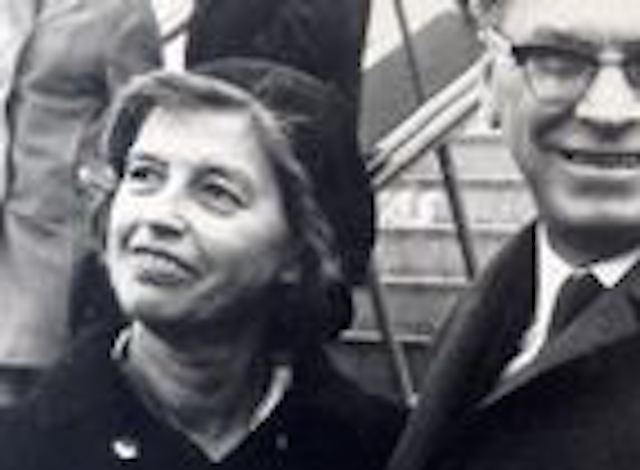
Hiltgunt Zassenhaus. Not a name that, once heard, you’re likely to forget. Yet Zassenhaus remains one of the more unheralded heroines of World War II.
Born in 1916 into an educated Hamburg family, Zassenhaus made a fateful decision early in life: to study Scandinavian languages in college. This initially lead to a cushy job—official interpreter to the Court of Hamburg. But when World War II began, Hiltgunt was pressed into service in a much different capacity: to read—and censor—letters from Jewish inhabitants of the newly created ghettos in Poland to their friends and relatives in Scandinavia. Rather than blacking out forbidden requests, she often added her own, to send food, in the margins of the letters, and smuggled them out of the country through a friend.
Later, Zassenhaus decided she could be of greater benefit as a physician, and began to study medicine. And yet again she was pressed into service by the German Justice Department, this time to accompany clergy from the Norwegian Seamen’s Church, who were permitted to visit prisoners. Her task was once again to censor each meeting, and especially to insure that no prayers or sermons were uttered. Again, rather than aiding the Nazis, Zassenhaus soon began to secretly smuggle food, vitamins and medicines into the prisons—right under the jailers’ noses. Risking certain death with each visit, laden with a bulging suitcase, Hiltgunt essentially bluffed her way past suspicious prison authorities who were even more fearful that she might well be a secret Gestapo agent send to spy on them.
As helpful as Hiltgunt’s actions were, she had one additional, even more critical, role to play. As Scandinavian prisoners were shunted from prison to prison, Zassenhaus, having developed personal relationships with many of them, insisted on visiting them wherever they were relocated. To keep track of all these movements (involving 52 different prisons), Zassenhaus developed a detailed card system for each prisoner, tracking their every move.
In the spring of 1945, Count Folke Bernadotte, head of the Swedish Red Cross (and a friend of Odd Nansen’s) successfully negotiated permission from Heinrich Himmler to assemble all Scandinavian prisoners in one camp (Neuengamme) with the ultimate goal of repatriating them safely home as soon as possible. This effort, dubbed the “white buses” operation for the white-painted Red Cross buses involved, suffered from one serious obstacle—no one in the Swedish Red Cross knew where all the Scandinavian prisoners were located, and if Himmler knew, he wasn’t saying.
Enter Zassenhaus’s card tracking system. As she later wrote: “[W]henever a prisoner could not be located, my file gave the answer.”
After the war, Zassenhaus completed her medical studies, emigrated to the U.S., and opened a practice in Baltimore. Her incredible story is told fully in her memoir, published in English in 1974: Walls: Resisting the Third Reich—One Woman’s Story (more about the book here).
Zassenhaus is the only German to be awarded Norway’s highest civilian decoration, the Order of St. Olav, bestowed as “a reward for distinguished services rendered to Norway and mankind.” (In this she shares something in common with Odd Nansen, who also received the award, in 1970.) In 1974 Norway went even further: their Parliament nominated Zassenhaus for the Nobel Peace Prize.
Despite all the dangers Hiltgunt faced in providing aid and comfort to her prisoners, she never flinched, and never wavered from her conviction that her cause was just. She once remarked: “[E]ven in the most desperate circumstances we as individuals can make choices. This is what humanity is about: we must never cease to listen to our consciences. It guides us toward serving life, then we are on the right course.”
I think that is a sentiment that Odd Nansen would have wholeheartedly supported.
Hiltgunt Margret Zassenhaus died twelve years ago today, on November 20, 2004, age 88.

