
Steinbeck Article Published

MHQ: The Quarterly Journal of Military History has just recently published an article I wrote about John Steinbeck and his World War II novel, The Moon Is Down.  I have previously written (here) about the number of parallels between Steinbeck and Odd Nansen.

The article, entitled “Piéce De Résistance,” describes Steinbeck’s transition from successful novelist to successful propagandist.  How successful?  One critic called The Moon Is Down “easily the most popular piece of propaganda in occupied Western Europe.”  It was translated and secretly circulated (at great personal risk) by underground resistance movements in virtually all the occupied countries of Europe (as well as China).  Winston Churchill found time at the height of the war to read it, and found it “a well-written story.”  (Perhaps it takes one to know one: both Churchill and Steinbeck would in later years receive the Nobel Prize for Literature).  Moreover, Steinbeck was treated like a hero wherever he traveled in Europe after the war.  It’s truly a fascinating story.

Here’s the link to the full article.

Enjoy!
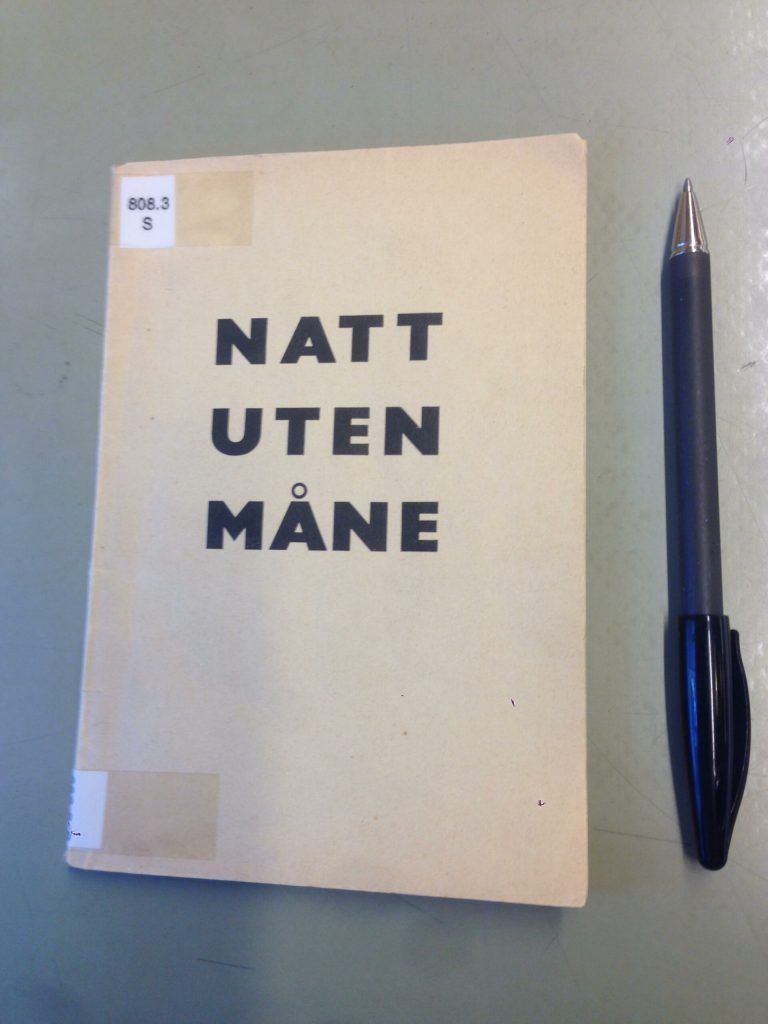
The Norwegian translation of The Moon Is Down

From Day to Day: One Man’s Diary of Survival in Nazi Concentration Camps

Hailed by The New Yorker as “among the most compelling documents to come out of the war,” From Day to Day is a World War II concentration camp diary—one of only a handful ever translated into English—secretly written by Odd Nansen, a Norwegian political prisoner. Arrested in January 1942, Nansen, son of polar explorer and humanitarian Fridtjof Nansen (Nobel Peace Prize 1922) was held captive for the duration of the war in various Nazi camps in Norway and Germany.

Nansen’s diary entries detail his palpable longing for his wife and family, his constantly frustrated hopes for release, the quiet strength and sometimes ugly prejudices of his fellow prisoners, and his horror at the especially barbaric treatment reserved for the Jews. The diary brilliantly illuminates Nansen’s daily struggle, not only to survive, but to preserve his sanity and maintain his humanity in a world engulfed by fear and hate.

First published in English in 1949, From Day to Day had been out of print for almost seventy years. The new edition contains entries and sketches never previously available in English. It also features a new introduction and extensive annotations by Timothy Boyce and a preface by Thomas Buergenthal, whose life (as a ten year-old) Nansen saved while in Sachsenhausen, later recounted in his own memoir A Lucky Child: A Memoir of Surviving Auschwitz as a Young Boy.