
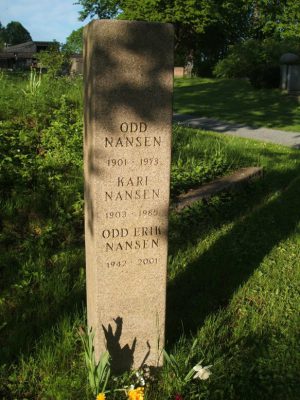
Odd Nansen died forty-nine years ago today, age 71.
The anniversary of his death always seems like an appropriate time for remembrance and reflection. (See my previous observations on this date in 2021, 2020, 2019, 2018, 2017 and 2016).
Recently I finished reading No Ordinary Time: Franklin and Eleanor Roosevelt: The Home Front in World War II by Doris Kearns Goodwin. In it, Goodwin describes the difficult, often painful, and yet highly productive, marriage between Franklin and Eleanor, and how bereft she felt at Franklin’s sudden death in Hot Springs, GA on April 12, 1945.
In her nationally syndicated newspaper column “My Day”* written just two weeks later, on April 26, 1945, Eleanor quoted a little verse sent to her by a friend she had not seen in a long while: “They are not dead who live in lives they leave behind: In those whom they have blessed they live a life again.” According to Goodwin, those simple lines inspired Eleanor to make the rest of her life worthy of her husband’s memory. “As long as she continued to fight for his ideals, he would continue to live.”
Eleanor, an awkward and often lonely child, certainly proved herself worthy of her husband’s memory. In December 1945, she accepted President Truman’s invitation to join the American delegation to the new United Nations. In doing so, she was “setting forth on a new journey into the field of universal human rights that would make her ‘the most admired person in the world’—and an important figure in American public life for nearly two more decades.”
What better way, on the anniversary of Odd Nansen’s death, to honor his memory, than to continue the fight for his ideals, and thus prove ourselves worthy of his legacy as well.
*Eleanor wrote about Fridtjof Nansen several times in her My Day column, but that is a matter for a future blog.

