
When did World War II in Europe begin?
Most people conveniently pick September 1, 1939, the day Germany attacked Poland (which I have previously written about here).
Some of my British friends maintain, however, that a conflict between two European nations hardly makes for a world war, and, as of September 1, no other nations were involved. It is true that both France and Great Britain had entered into military alliances with Poland, promising to defend it in the event of an attack. But military agreements, no matter how binding they might seem, are not the same as a declaration of war.
Thus, it was that France’s foot dragging, combined with Great Britain’s reluctance to act unilaterally in the absence of France’s agreement, which resulted in a 48-hour delay between Germany’s invasion of Poland and Great Britain’s ultimatum of September 3, demanding Germany agree within two hours to withdraw its troops from Poland. When the ultimatum’s deadline came and went without any German response, Great Britain finally declared war, as did France.
Thus, my British friends have a point when they contend (along with the Encyclopedia Britannica) that the true start of the war was September 3, 1939.
The first British casualties of the newly declared war were neither British soldiers, sailors, nor airmen. Instead, they were the unlucky passengers aboard the SS Athenia, a transatlantic passenger ship owned by the Donaldson Atlantic Line. Departing Glasgow on September 1, destination Montreal, the Athenia was the largest ship in the Donaldson Atlantic Line fleet, carrying 1,103 passengers (including about 500 Jewish refugees) and crew.
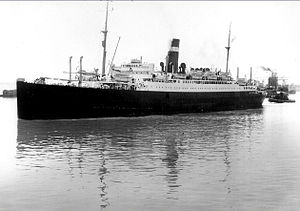
Late on the afternoon of September 3, the Athenia was located northwest of Inishtrahull, the northernmost island of Ireland, off the coast of Donegal. When news of the declaration of war reached the ship, the concerned passengers consoled themselves that: 1) they were carrying no military supplies, 2) they were unarmed, and 3) they were sailing west, away from the conflict, and thus presented no threat to Germany.
In fact, one of the passengers was just in the midst of explaining this rationale to the other passengers when the ship was struck by two torpedoes fired by German U-boat U-30, captained by Fritz-Julius Lemp. Lemp would later claim that he mistook the Athenia—sailing in a zigzag pattern in blackout conditions—as either a troopship or an armed merchant cruiser. Under the Hague Convention, warships, including submarines, had the right to stop and search merchant vessels. However, merchant vessels could neither be captured nor sunk unless they were either carrying contraband or engaged in military activity. Even in such cases, the enemy commander was obliged to transfer passengers and crew to a “place of safety.” Lemp, by sinking an unarmed passenger ship without warning, and by failing to aid any of the affected passengers, had violated all such rules of conduct.
Unlike the USS Indianapolis, which sank in 11 minutes, (which I have written about here) the Athenia stayed afloat for more than 14 hours, allowing for 1) transmission of multiple distress signals, and 2) a somewhat more orderly evacuation of the ship. Nevertheless, 98 passengers and 19 crewmembers died, either as a result of the torpedo explosions, or from various mishaps involving the lifeboats.
Hearing the distress signals, three British destroyers, a Norwegian cargo ship, the Knute Nelson, a Swedish yacht, Southern Cross, and an American cargo ship, the SS City of Flint, all rushed to the scene, and saved the remaining survivors.
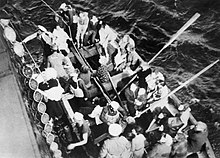
Fearing international condemnation for the unwarranted and illegal attack, and especially of antagonizing the United States (28 of the dead were American citizens) the Germans denied any involvement in the sinking. Instead, they accused the British of a hand in the tragedy, purportedly motivated by a hope of inflaming anti-German sentiment in the U.S. It was not until the Nuremberg Trial of Grand Admiral Erich Raeder in 1946 that the true fate of the Athenia was revealed.
The Athenia (named after Athena, the patron goddess of heroic endeavor) thus became the first British ship to be sunk during World War II, heralding the Battle of the Atlantic. It was the first of 2,223 British and Allied merchant ships to meet such a fate during the course of the war.
Some of my more astute readers may have noticed that I referred, in the title to my blog, to the Athenia(s).
Here’s where the tragedy goes from bad to worse. The Athenia, which was built in 1922, was the second ship to bear such a name. It was christened Athenia to pay tribute to an earlier passenger and cargo ship, built in 1903 and also owned by the Donaldson Line, and also called the Athenia.
And guess what?
The first Athenia was also sunk, (during World War I: August 16, 1917), also by a German U-boat, and also off the coast of Inishtrahull, resulting in the deaths of 15 passengers (as well as over 400 horses).
Mark Twain is reported to have once said that history does not repeat itself, but it often rhymes. Here’s a case where he just might have been wrong.
Needless to say, the Donaldson Atlantic Line wisely chose not to name any of its other ships Athenia in honor of its predecessors. Whether its other passenger and cargo ships thereafter stayed far away from the coast of Inishtrahull is not known.
Trivia Notes:
- Fritz-Julius Lemp was later killed in action when the U-boat he was then commanding, U-110, was captured on May 9, 1941, off Cape Farewell, Greenland, by the British Navy.
- The passenger list for the Athenia consisted of a veritable Who’s Who, including actors and actresses, government officials, educators, and writers, as well as the following survivors:
- James Goodson, a future US Army Air Force ace.
- John Lawrence, called the father of nuclear medicine and brother of noted physicist Ernest O. Lawrence.
- Bill Gadsby, future Hall of Fame professional hockey player.
- Margaret Doggett, future wife of real estate developer Trammell Crow, and future mother of Harlan Crow, controversial friend of Supreme Court justice Clarence Thomas.
- The SS City of Flint had an equally eventful career after rescuing approximately 200 passengers from the SS Athenia. Barely a month later, on October 9, 1939, she was captured by the German Navy, the first U.S. ship seized during the war. Unable to bring their prize ship safely back to Germany, and pursued by the Royal Navy, the Germans allowed the U.S. crew of the City of Flint to unload its cargo in Norway and set sail for America. Its luck did not last, however. It was sunk on January 23, 1943 by German U-boat U-575.

