
Last week marked the second anniversary of the re-publication of the deluxe, fully edited and annotated World War II concentration camp diary of Odd Nansen, From Day to Day: One Man’s Diary of Survival in Nazi Concentration Camps.
For those of you keeping tabs (and who isn’t), here’s a brief scorecard:
- 24,692 Miles traveled
- 5,448 Website visitors
- 5,206 Dollars donated
- 75 Presentations
- 64 Blog posts (this is #65)
I celebrated this important anniversary doing what I like to do best—talking about Nansen and his remarkable diary. On April 18, I embarked on a ten-day, six-city tour, which ended in New York City, with stops along the way in several cities in New Jersey. 2,036 miles later, I can say it was all very worthwhile.
Virtually every stop along the way featured some fascinating encounter:
- In Caldwell, NJ, an elderly audience member at the Public Library introduced herself to me after the talk, and explained that she had come to America decades ago by virtue of the Nansen Passport, a unique document pioneered by Fridtjof Nansen that allowed many stateless Europeans, particularly White Russians, to travel freely in the interwar period. [It so happens that I have written an article on the Nansen Passport which should be published later this year—stay tuned.]
- In Upper Saddle River, NY, I was feted by the Sons of Norway Norrona Lodge. The members generously took up a collection for me, to help support the “cause,” and all such proceeds will go to the same recipients as the book’s royalties: The U.S. Holocaust Memorial Museum in DC and the Center for the Study of the Holocaust and Religious Minorities in Oslo. On top of that, the Lodge presented me with a gift basket filled with Norwegian goodies. While my wife and I have been thoroughly enjoying the chocolates (with exotic names like Firkløver, Melkesjokolade and Gullbrød), it may take a bit longer to work up the courage to open the tinned mackerel (a good source of Omega-3 it boasts!). All I can say is: “Takk for maten!”
- At Bernards Township Public Library I discovered that the Library Director, Ruth Lufkin, had a son who graduated from the U.S. Naval Academy the same year as my son Owen. Go Navy, Beat Army!
- A surprise visitor to the Summit Public Library was my brother-in-law, John McGowan and his son Nicholas. (A great steak dinner followed the talk, courtesy of John.)
- A speech to the Old Guard of Princeton held the biggest surprise of all. Afterward I met a gentleman (whose privacy I will protect) who produced one of the actual breadboards used to smuggle parts of Nansen’s diary out of the camps at the close of the war. It belonged to the grandfather of this man’s wife. Talk about a real treasure! That revelation will be hard to beat for quite some time, if ever.
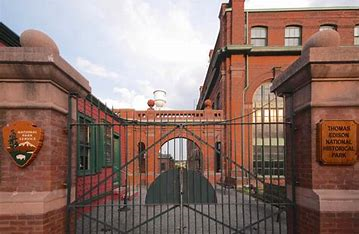
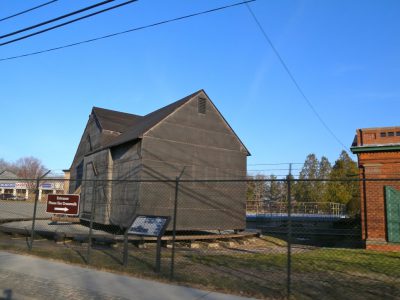
The trip was not all work. In between appearances I spent a day at the site of Thomas Edison’s research labs in West Orange, NJ (now a National Historical Park). There, Edison, an autodidact, perfected the incandescent light bulb, the gramophone, and the movie camera, along with many other inventions (he ultimately held over 1,000 patents). The site also boasts the first movie production studio, and the first movie theater (in Edison’s library). If you ever visit, ask for Harry, a volunteer with his own long career at Bell Labs and a passion for discussing all things Edison.
A day later, courtesy of my hosts Kathy Aleš and her husband Richard, I was able to attend a guest lecture by Lech Walesa, 1983 Nobel Peace Prize laureate, at Princeton University. Although Walesa used an interpreter, his body language was at least as expressive as the actual speech. He reminded the young audience that the Solidarity Movement had exactly zero chance of succeeding when it started, and yet it ultimately brought about the end of communist domination of Poland, and the end of communism altogether. In other words any change, no matter how hopeless seeming, is possible.
Finally, I was able to spend time with an old friend, Samuel Hynes, the Woodrow Wilson Professor emeritus of Literature at Princeton University. Sam has published extensively during his career (Flights of Passage, A Soldier’s Tale, A War Imagined, The Insubstantial Air, The Growing Seasons, among others), and, at age 93, isn’t slowing down much: he just published a new collection of essays and writings entitled On War and Writing (University of Chicago Press), which was recently reviewed in the New York Review of Books (by Max Hastings, one of my favorite historians).
During World War II Sam flew as a young Marine aviator in the South Pacific, earning the Distinguished Flying Cross. Afterwards he taught Literature at Swarthmore, Northwestern and Princeton. [In the Introduction to his new book, entitled “Two Vocations,” Sam writes: “From then on they [the Professor and the Pilot] worked together—the Pilot writing and the Professor looking over his shoulder, watching for split infinitives.”] You may remember Sam as the first talking head to appear on Ken Burns’ miniseries “The War.” When our conversation turned to favorite poets, Sam started reciting Yeats by heart—an amazing display—and altogether an amazing afternoon. [I plan to use some of Sam’s writings in a future blog—stay tuned as well.]
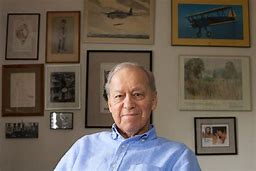
So, all in all, it was a trip to be remembered. Thanks to all my friends along the way who provided hospitality and support. You know who you are.
As I turned my 2,036th mile pulling into my driveway, late last Friday night, I was greeted by a welcoming sound: the Eastern Whippoorwill had finally returned from his long sojourn in Mexico, and was busily singing out his mating/territorial call. Music to my ears!
As I brought my bags into the house, I was reminded of those immortal words of Sam Gamgee on the final page of The Lord of the Rings: “He drew a deep breath. ‘Well, I’m back,’ he said.”

