
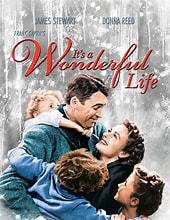
Today marks the 78th anniversary of the first screening of one of my favorite films, Frank Capra’s It’s a Wonderful Life. Originally slated to be released in January 1947, the movie’s premier was moved up to December 20, 1946 in order to qualify for that year’s Academy Awards. Although nominated in five categories, including Best Picture, the movie won only one award, in Technical Achievement, for its new method of simulating falling snow (using a combination of water, soap flakes, foamite and sugar). It is ranked No. 1 on the American Film Institute’s list of the Most Inspiring Films Of All Time. When the copyright expired in 1974, allowing it be broadcast without licensing or royalty fees, the movie quickly became a Christmas classic.
You all know the movie (or should). Here’s a brief recap. In the space of 131 minutes, George Bailey (Jimmy Stewart) manages to:
- Save his little brother Harry from drowning, thereby ultimately saving the lives of numerous sailors targeted for a kamikaze attack.
- Save old man Gower from prison for accidentally poisoning a diphtheria prescription.
- Save the Bailey Brothers Building & Loan from closure by agreeing to forego a vacation trip and college (instead sending brother Harry to school in his place).
- Save Uncle Billy from being institutionalized if the Building & Loan had failed.
- Save the Building & Loan, again, this time from insolvency (and Potter’s clutches) by using his honeymoon money to stem a run on the bank during the Depression.
- Save Mary Hatch from spinsterhood (!) as the town librarian.
But of course George doesn’t realize all the good he’s done. It takes the combined efforts of Clarence Odbody, the angel, to show him what Bedford Falls would be like without him, and his wife Mary, who rallies George’s many friends during his financial crisis, to show him what a wonderful life he’s in fact had. We, like him, come to realize the power a single individual can have to change things for the better.
Does that remind you of anyone else?
How many lives did Odd Nansen affect, in and out of prison?
How about the many refugees Nansenhjelpen was able to bring to Norway before World War II began.
And then there is Tom Buergenthal:
“Much later I realized that Mr. Nansen had probably saved my life by periodically bribing the orderly in charge of our barrack . . . to keep my name off the list of ‘terminally ill’ patients which the SS guards demanded every few weeks ‘to make room for other inmates.’”
Tom Buergenthal may have been the most extreme example of Nansen’s impact, but there were others.
On November 12, 1943, a month after arriving in Sachsenhausen, Nansen describes how he has taken charge of “a little Russian student, as frail and wan as a young bird,” whose only claim upon Nansen is that his father knew Fridtjof Nansen. Nansen promises to restore the boy with doses of train oil, along with “butter, bread, sardines, and cheese too.” One year later, on December 14, 1944, Nansen observes more generally:
“It isn’t well to be “well-off” among so many who are badly off. The only possible relief is to share the material goods which are divided among us so unequally and unjustly. To see a starving, broken-down Ukrainian eat his fill is a far richer and deeper satisfaction than most this life can offer.”
Finally, on December 18, 1944, Nansen relates in his diary how a Jewish builder from Budapest gives him a modest gift—a neatly wrapped cigarette, in gratitude for Nansen’s past generosity, promising to “give me the same present in gold and precious stones” after the war.
I recently finished reading Memories of Our Fathers, edited by Gaby Hasenjürgen. In the course of interviewing Norwegian concentration camp survivors and/or their children, Hasenjürgen relates one former prisoner saying “I came to know Odd Nansen very well [in Grini prison camp]. He was a head person. . . . I always liked to meet him. We were youngsters and looked up to him.”
Even after the war, Nansen continued to affect the lives of many when he donated the royalties from the German translation of From Day to Day to assist German refugees, and in his efforts as temporary assistant to the director general of UNESCO.
According to Director Frank Capra, “Of all actors’ roles I believe the most difficult is the role of a Good Sam[aritan] who doesn’t know he is a Good Sam[aritan].” Capra knew one man who could play such a role—Jimmy Stewart. Capra might have thought the same of Nansen had he known him.
Orville Prescott, the New York Times’ daily book critic, called Nansen’s diary “a magnificent and utterly un-self-conscious self-portrait.” Similarly, Anne Goodman, writing in the New Republic, thought Nansen exhibited a “great unconscious charm” whose “quick, broad and compassionate personality shines through.” Alfred Werner, in the New York Times Book Review, felt Nansen was “imbued with a spirit of unbelievable humility” which “the reader will, unquestionably, find himself drawn to.”
So, in this Holiday Season, and throughout the coming year, we could ask ourselves each day “What would George Bailey do?” Not a bad question, but since George Bailey is only a fictional character, perhaps the better question we should instead be asking ourselves is, “What would Odd Nansen do?”

