
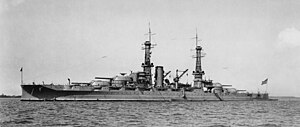
What do the USS Arizona and USS Indianapolis have in common?
At first glance, not much.
The first was a battleship; the second a heavy cruiser. One was named after a state; the other, a city. The Arizona was the first major U.S. ship to be sunk by the Japanese in World War II, 83 years ago today; the Indianapolis was the last. The Arizona lies in water so shallow the hull can be seen just below the surface; the Indianapolis lies under 18,000 feet of water in the Philippine Sea (it was finally only located in 2017).
And yet.
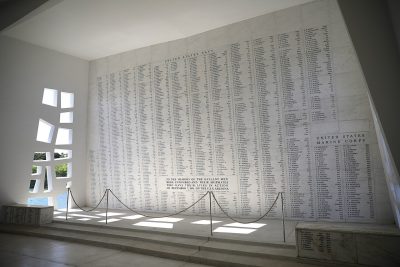
I have had the honor of visiting the USS Arizona Memorial on two occasions. A 10-minute skiff ride from the mainland brings you to the Memorial. At the opposite end of the disembarkation point is a solid wall made up of white marble squares. Engraved on the squares are the names of the 1,177 officers, crewmen and Marines who perished on the Arizona on the morning of December 7, 1941.
On my first visit to the Memorial, I also noticed a marble square on the lower left portion of the wall, also with names engraved upon it, but it was clear that these names had been added at different times. I asked a nearby U.S. Park Ranger for the meaning of this separate square, and learned that these names represented sailors from the Arizona who had not perished in the attack, but had died in the following decades, and yet whose final, dying, wish was to be interred with their colleagues entombed in the hull of the sunken battleship.
Think about that.
Here are men, many of them quite young—mere boys—when the attack on Pearl Harbor occurred. They survived that attack, survived the war, at some point probably fell in love, married, and had a family, perhaps even grandchildren. Some undoubtedly had successful and fulfilling careers. And yet their most important decision, their final, irrevocable wish, was to join their crewmates, some of whom they probably barely knew (the total crew complement on the Arizona was 1,512 men). That event loomed larger than any other experience they would ever have.**
So you will not be surprised to learn about the following news item I came across while researching the blog I posted this past July 30, about the tragedy of the USS Indianapolis. The dateline is November 1, 2008, from the Associated Press. It relates the story of Machinist Mate 1st Class Jason Witty, a crewmember of the USS Ohio, a ballistic missile submarine. His grandfather, Boatswain’s Mate 2nd Class Eugene Morgan, was one of only 316 survivors of the sinking of the Indianapolis.
The torpedo explosion that sank the Indianapolis threw Morgan from his rack, but he managed to struggle topside and jump off the port side of the ship as it started to capsize. According to Witty, “At some point he found some food floating on the surface and swam toward it. But on the way he was attacked by a shark.” The shark swam away before going back in for the kill; Morgan would carry scars on his backside from the attack for the rest of his life.
When Morgan, who became a Seattle firefighter after the war, died in June 2008, age 87, it was up to his grandson Witty to carry out his final wish: to have his ashes join his shipmates at the spot where the Indianapolis went down 63 years earlier. The Navy quickly agreed to honor Witty’s request; the burial at sea occurred on October 2, 2008.
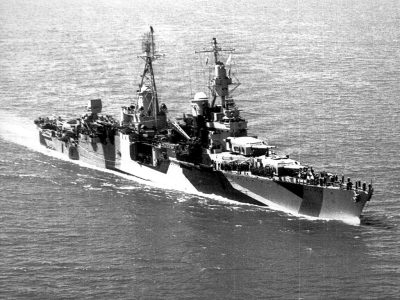
Perhaps the Arizona and the Indianapolis have more in common than we thought.
Eternal Father, strong to save,
Whose arm hath bound the restless wave,
Who bid’st the mighty ocean deep
Its own appointed limits keep;
O hear us when we cry to Thee,
For those in peril on the sea.
* = Photo by Gage Skidmore, Surprise, AZ
** = The last known Arizona survivor of the Pearl Harbor attack, Lou Conter, died this past April, age 102.

