Who penned these lines:
“Mankind was my business, the common welfare was my business; charity, mercy, forbearance, were all my business. The dealings of my trade were but a drop of water in the ocean of my business.”
and
“The worst crime you can commit against yourself and society, is to forget what happened and sink back into indifference. What happened was worst than you have any idea of — and it was the indifference of mankind that let it take place.”
Those of you who have read Odd Nansen’s diary From Day to Day all the way through, are familiar with the second quote as the admonition with which Odd Nansen ends the postscript he added to his diary as it was about to be published.
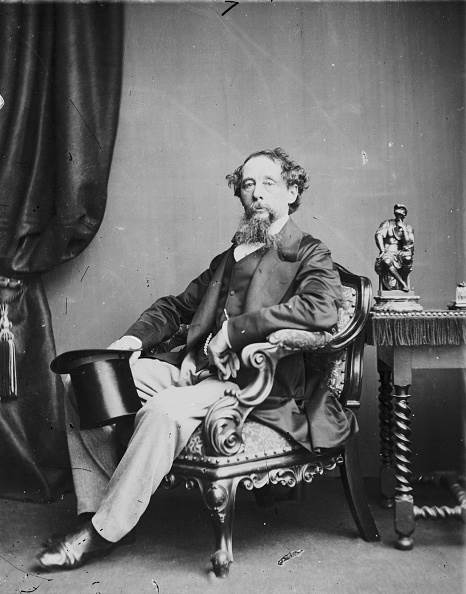
The first quote comes from Charles Dickens (or, more accurately, the ghost of Jacob Marley) in Dickens’s A Christmas Carol, which was first published 182 years ago today.
Dickens was angered by social conditions prevailing in Victorian England of the time—child labor and debtor’s prison among them. Dickens himself had been forced himself to leave school at age 12 to work long hours at a rat-infested shoe-blacking factory when his father fell on hard times financially. He concluded that the best way to change these conditions was by reaching the broadest possible audience, and that was via a work of imagination centered on Christmas, rather than on a fact-based, polemical pamphlet.
Writing “at white heat,” Dickens was able to complete, in six short weeks, his meditation on Scrooge, and the capacity of one person to change. First published on December 19, 1843, the initial print run of 6,000 copies of A Christmas Carol was sold out by Christmas Eve. Two more printings were run before the end of 1843, and eleven more printings followed in 1844.
It is easy to see how Dickens’s words and Nansen’s words, written almost 100 years apart, are in a sense two sides of the same coin. Marley’s words are an admonition—a plea that Marley urgently passed on to his partner Scrooge; Nansen’s words describe a world where Marley’s words went unheeded. Similarly, Nansen could easily have penned Dickens’s exact words himself. His diary, after all, is the very embodiment of them; mankind was his business.
Aware of his own good fortune (to be a Scandinavian prisoner, and thus allowed to receive food parcels in prison), but with “starving, shattered human beings who surround one everywhere in the camp,” Nansen concludes “It isn’t well to be ‘well off’ among so many who are badly off. The only possible relief is to share the material goods which are divided among us so unequally and unjustly.” When Nansen was on the receiving end of an act of generosity, he was fully aware of its significance. Condemned to a solitary, punishment cell for running afoul of the camp’s commandant, Nansen later reflected on the experience:
“Here the solidarity and comradeship was better than anywhere else in the camp, better indeed than anywhere else I know of. Unseen, unknown lads . . . many of them being tortured under questioning, many filled with the dread of torture; some awaiting a death sentence; many with nothing left but hope, and some without even that; all willing to share the little they had with one another, all ready to help a comrade in need of food and clothing, with word and deed. Of all my long time in prison, which lasted forty months, I think those eight days were the most impressive and the best.”
Conversely, there is something in Dickens’s fable which, like Nansen’s diary, continues to strike a chord in us today and inspire us to be better. It’s not surprising that his short novella has never been out of print since it first appeared 182 years ago and has been adapted for film and television more than any of Dickens’s other works.
And so, in the spirit of Ebenezer Scrooge and Odd Nansen (and George Bailey too), let us “honor Christmas in [our] heart[s], and try to keep it all the year.”
And that’s no humbug!