
In the past few weeks much of the nation has been beset by unusually cold and snowy weather. In fact, this January was the coldest such month in the contiguous United States since 1988. Nearly everyone has been discomfited in one way or another. Even here in western North Carolina, the so-called Isothermal Belt, where temperatures are expected to be somewhat temperate, things were pretty cold this morning when I took our dog out for her morning walk. I was thankful for my warm clothes: ski cap, polar fleece pullover, insulated and padded coat, and sturdy boots. Even with all that we hurried along, eager to return to the warmth and security of our home.
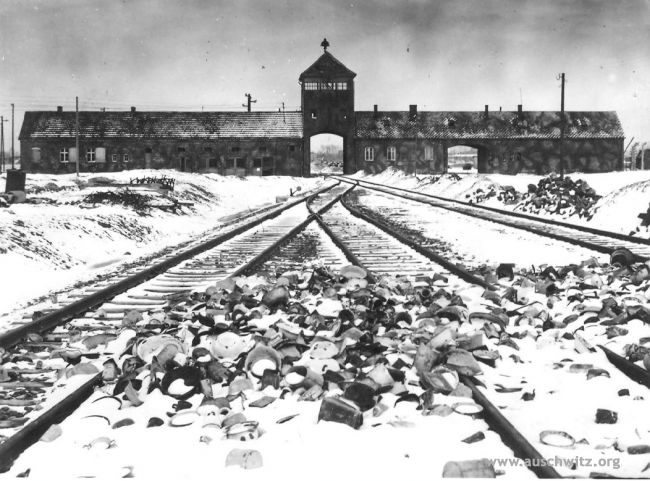
That experience provides an appropriate backdrop for revisiting the recent anniversaries of the evacuation and liberation of Auschwitz eighty-one years ago and, in particular, the fate of one ten-year-old prisoner named Thomas Buergenthal.
On January 18, 1945, Tom, along with approximately 56,000 other prisoners, evacuated Auschwitz, and began what is now referred to as the Auschwitz Death March. Clad in cotton prison uniforms, some with blankets, some without, some with boots, some with wooden clogs, some with rags tied round their feet, those inhabitants of Auschwitz who could walk set out into the Polish winter. According to Professor Daniel Blatman, an authority on the death marches, temperatures in the area “dropp[ed] to -10° to -15°C,” or 5° to 14° F.
As Tom relates in his memoir, A Lucky Child, between January 18 and January 21 he walked 70 kilometers (42 miles), sleeping on the frozen ground at night. By the time he reached Gliwice, Poland, on the third day, he could no longer feel his toes. There he ate his remaining bread ration and licked a few handfuls of snow. “Oh, what would I have given for even a few spoonfuls of that terrible Auschwitz turnip soup or, for that matter, anything warm!” he writes.
At Gliwice Tom was herded onto an open cattle car. At first the warmth of the overcrowded car was an asset, but as prisoners died and their bodies were thrown over the side, even that advantage faded. “The snow and wind seemed never to let up, and we could feel the cold more now than before because there were fewer warm bodies pressing against us.” With his bread gone, Tom was reduced to eating snow, imagining it tasted like ice cream, “although I doubt that we remembered what ice cream tasted like.”
How such cruelty could be visited upon a ten-year-old boy, for no other reason than his Jewish birth, is a question that both perplexes me, no matter how much I read up on the subject, but also frightens me, as the disease of anti-Semitism once again gains virulence, even here in America.
Was there any saving grace, or silver lining, to be extracted from the experience of the Death March? Hardly. Thousands of marchers—one out of every four prisoners who left Auschwitz—died in the process, a mere 100 days before the war’s end. Upon his arrival in Sachsenhausen after ten days in the cattle car, Tom had several of his frostbitten toes amputated. But in a strange twist of fate, that very injury placed him in Sachsenhausen’s Revier III (Infirmary No. 3), which also housed one of Odd Nansen’s Norwegian friends. It was while visiting his friend that Odd first encountered young Tommy, so young and so innocent that Nansen called him “one of Raphael’s angels.” Otherwise, the chances that Tom and Odd would ever have crossed paths in a camp as large as Sachsenhausen were almost negligible. And that improbable meeting proved a boon to both Nansen and Buergenthal. As I have lectured, that chance meeting changed both of their lives. Nansen saved Tommy by bribing the orderlies in the Revier to protect him; Tommy in turn “accomplished with us a work of salvation. . . . He called to life again human feelings, which were painful to have, but which nevertheless meant salvation for us all.”
Even in the darkest hours there were a few other gleams of light. Saul Friedländer, in his book The Years of Extermination, recounts the experience of another Death March participant, Paul Steinberg, who had “’a precise, detailed, overwhelming memory.’” When Steinberg’s train approached Prague, Czechoslovakia, it passed under bridges where Czechs were marching overhead on their way to work.
“’As one man,’ Steinberg recalls, ‘the Czechs opened their satchels and tossed their lunches down to us without a moment’s hesitation. . . . We were showered with rolls, slices of bread. . . .’”
Tom Buergenthal had a similar experience:
“Just when I was sure that it would only be a matter of a day or two before I too would die and be thrown out of the car, a miracle occurred. As the train moved slowly through Czechoslovakia, . . . men, women and children standing on the bridges we passed under [began tossing bread loaves into the cars] . . . . Had it not been for that Czech bread, we would not have survived. I never learned how this magnificent campaign had been mounted, but as long as I live, I will not forget these angels—for to me they seemed to be angels—who provided us bread as if from heaven.”
Think about all that next time you complain about the cold.
[Portions of this blog previously appeared in 2018, 2021, and 2025.]

